What is Embedding
Embedding - Vector representation
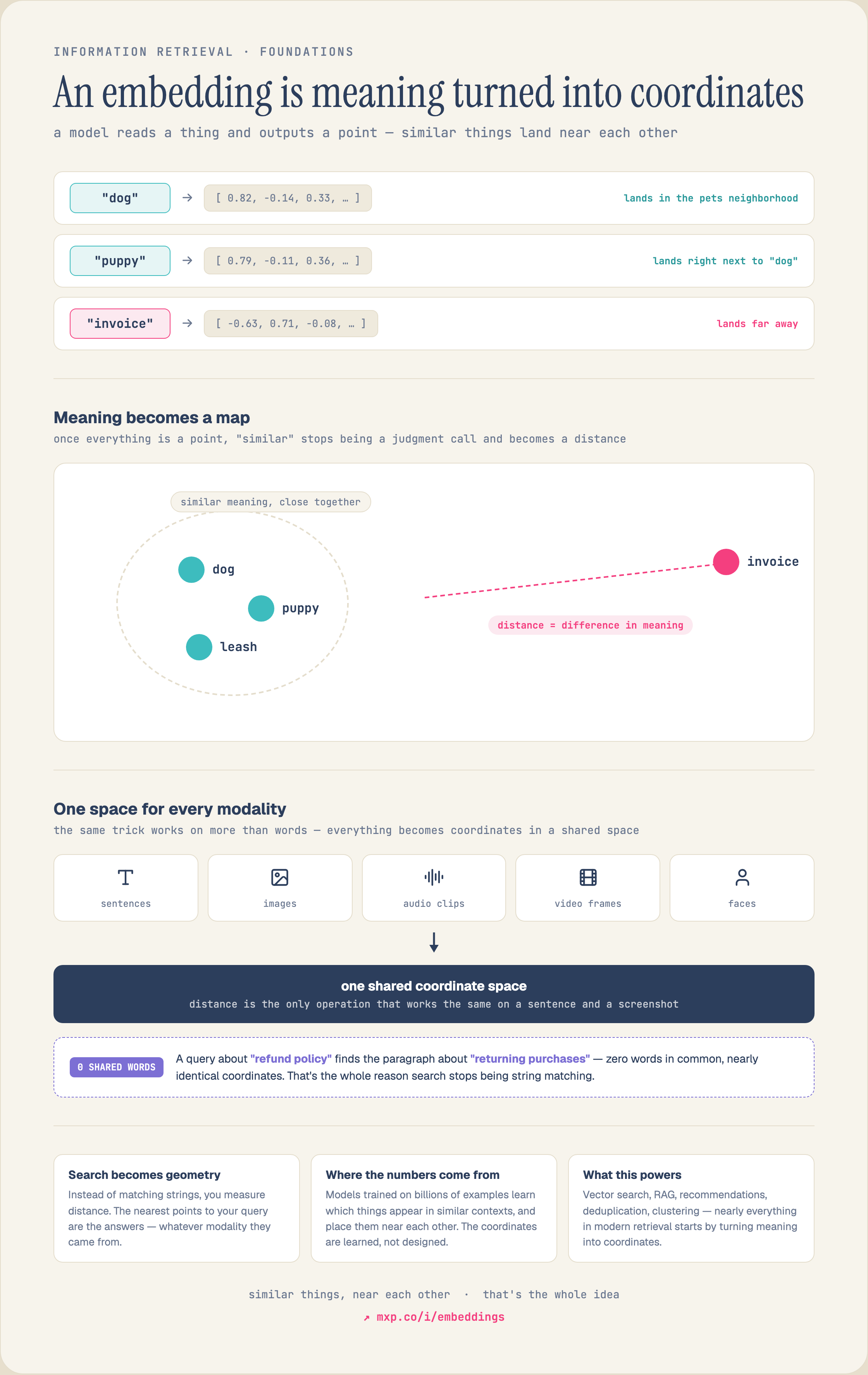
A dense vector representation of data (text, image, audio, video) in a shared semantic space that enables similarity operations and cross-modal queries.
How It Works
Embeddings convert high-dimensional data into dense vectors that capture semantic meaning. These vectors enable similarity comparisons and can be used for search, clustering, and other machine learning tasks.
Technical Details
Generated using neural networks trained on large datasets. Different architectures are used for different modalities (e.g., BERT for text, ResNet for images). Vectors typically range from 256 to 1536 dimensions.
Best Practices
- Choose appropriate embedding models
- Consider dimensionality trade-offs
- Implement efficient storage strategies
- Regular model updates and maintenance
- Monitor embedding quality
Common Pitfalls
- Poor model selection
- Ignoring domain-specific requirements
- Inefficient storage strategies
- Lack of quality monitoring
- Inadequate maintenance
Advanced Tips
- Use task-specific fine-tuning
- Implement embedding distillation
- Consider multi-modal embeddings
- Optimize for specific use cases
- Regular quality assessment
Put multimodal search to work
Connect a bucket and Mixpeek runs the whole multimodal search pipeline for you: extraction, indexing, and search over your own objects. No models to wire up, nothing to host.
Start with ManagedAlready have vectors?
Keep your embeddings on your own cloud and run dense, sparse, and BM25 search directly on object storage. From $25/mo.
Start with MVS