NEWVectors or files. Pick a path.Start →
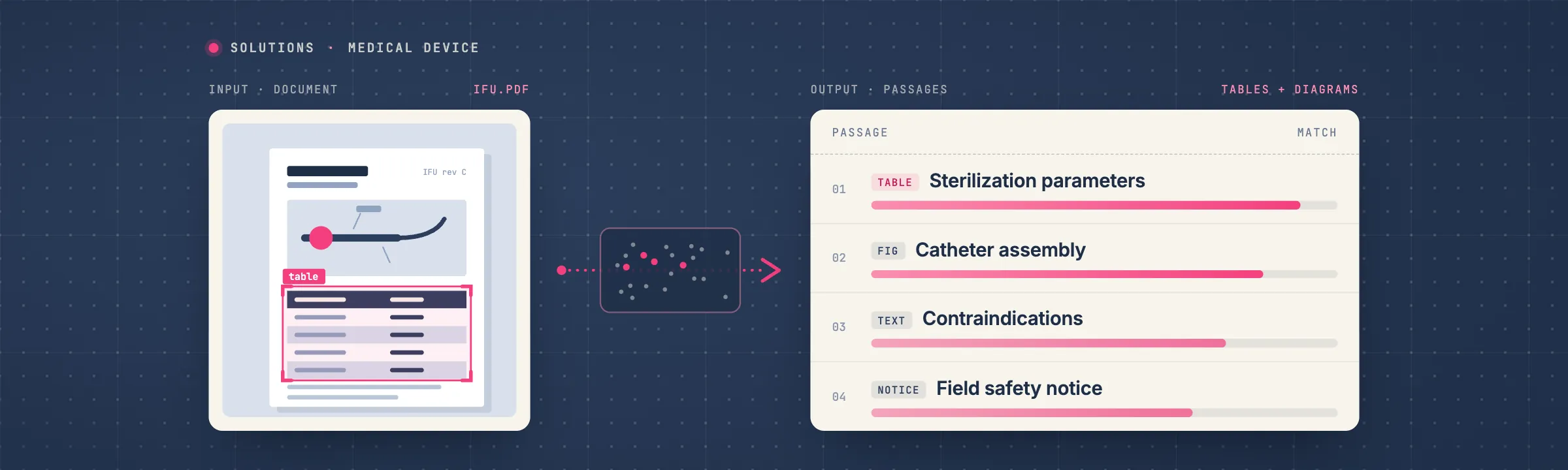
    Medical Device: an example input and what Mixpeek returns for it

    Cut FDA Audit Prep Time by 90%

    Search across IFUs, recalls, FSNs, and MAUDE reports-including tables, diagrams, and risk matrices-with 92% accuracy. Built for RA, QA, and PMS teams.

    Outperforms GPT-4o, Gemini, and Claude on regulatory documents.

    Benchmarked: IFUs, FDA recalls, FSNs, MAUDE reports, FMEAs, ISO 14971 risk files

    Trusted by Regulatory Affairs, Quality Systems, and Post-Market Surveillance teams navigating FDA audits, EU MDR compliance, and global vigilance workloads.

    Medical Device Document Retriever
    mixpeek.com/demo
    1
    2
    3

    Interactive retriever playground

    Launch Full Retriever

    Multimodal Extraction

    Tables, diagrams, schematics, FMEA matrices, and warning symbols with structural accuracy.

    Diagram-Aware Search

    Find assembly drawings, flowcharts, and schematics by description-not filename.

    Multi-Hop Retrieval

    Link recalls ↔ IFUs ↔ MAUDE events ↔ CAPAs across thousands of documents.

    See It In Action

    From messy IFU PDF to structured, queryable data in seconds.

    Before: Raw IFU PDF

    // Embedded warning section...

    WARNING

    Do not operate device if battery pack shows signs of thermal degradation or swelling.

    // Assembly diagram (figure 3.12)...

    [Assembly Diagram - not searchable]

    // Multi-column layout, headers span rows, no context...

    After: Structured JSON
    {
      "device_name": "X200 Infusion Pump",
      "doc_type": "IFU",
      "manufacturer": "MedTech Inc.",
      "warnings": [
        {
          "text": "Do not operate if battery pack shows thermal degradation",
          "severity": "critical",
          "source": "p.44, section 5.2"
        }
      ],
      "diagrams": [
        {
          "type": "assembly",
          "caption": "Cassette assembly steps",
          "source": "figure 3.12, p.28",
          "searchable": true
        }
      ],
      "related_recalls": ["FDA-2023-1154"],
      "similar_adverse_events": ["MDR-2024-00123"]
    }
    100%
    Source attribution
    Diagrams
    Fully searchable
    Linked
    Cross-doc references
    JSON
    API-ready output

    Capability Benchmarks

    Tested on 500+ IFUs, FSNs, recalls, and 5,000 MAUDE reports. These benchmarks measure regulatory-specific capabilities, not general intelligence.

    Table Extraction

    92.4%
    Cell Accuracy

    Cell-level accuracy extracting FMEA matrices, specification tables, and risk matrices with merged cells and multi-level headers.

    Mixpeek92.4%
    GPT-4 Vision63.1%
    Google Doc AI70.4%
    96.8% header detection
    88.3% merged cell handling
    Full row/column labeling

    Diagram Retrieval

    5.4×
    vs. Text-Only Search

    Improvement over text-only search when retrieving assembly drawings, flowcharts, schematics, and labeled component diagrams.

    Mixpeek (CLIP Hybrid)5.4×
    Vector Only2.1×
    BM25 Only1.0×
    CLIP + BGE fusion
    Caption-aware retrieval
    OCR text extraction

    Retrieval Precision@3

    91%
    Top-3 Accuracy

    Percentage of queries where the correct IFU section, recall, or MAUDE report appears in the top 3 results.

    Mixpeek (Hybrid)91%
    Vector Only78%
    BM25 Only69%
    Hybrid vector + keyword
    Cross-modal fusion
    Regulatory-domain tuning

    These benchmarks test specific regulatory document capabilities. GPT-4 is a better general assistant-we're a better regulatory document parser. Different tools for different jobs.

    How It Works

    Two pipelines working together to transform regulatory documents into answers

    Extraction Pipeline

    📄
    IFUs, Recalls, FSNs
    PDF, DOCX, HTML
    →
    🔍
    Layout Detection
    Tables, Diagrams, Text
    →
    📊
    Structure Extraction
    FMEA, Specs, Warnings
    →
    🧠
    Multimodal Index
    BGE + CLIP Embeddings

    Retrieval Pipeline

    ❓
    Natural Query
    "battery warnings pump"
    →
    🔀
    Hybrid Search
    Sparse + Dense + CLIP
    →
    🎯
    Cross-Encoder Rerank
    Precision scoring
    →
    ✅
    Cited Results
    Page, Section, Figure

    Why Generic LLMs Fail at Regulatory Documents

    GPT-4, Claude, and Gemini are great general assistants-but regulated documentation needs specialized extraction.

    ProblemGeneric LLMsMixpeek
    Diagram/figure search
    Cannot retrieve or search diagrams by content
    Full diagram extraction + CLIP hybrid retrieval
    Table structure
    Breaks row/column relationships in FMEA tables
    92.4% cell accuracy with source attribution
    Cross-document linking
    No memory across IFUs, recalls, MAUDE reports
    Multi-hop retrieval linking related documents
    Version control
    Confuses older vs. newer IFU versions
    Version-aware metadata + section diff
    Regulatory language
    Literal keyword matching, misses synonyms
    Semantic, regulatory-domain search
    Risk matrices
    Fails on FMEA severity/probability tables
    Embedded risk tables fully queryable
    Complete coverageAudit-readyCross-doc analysisTraceableSemantic understandingRisk file ready21 CFR Part 11 ready

    Share with Your Team

    Download the 2-page executive brief with ROI model, time savings by activity, and implementation timeline.

    Download PDF

    Use Cases

    Transform how your RA, QA, and PMS teams work with regulatory documentation

    FDA Audit Preparation

    Retrieve all relevant IFU sections, test reports, risk controls, and supporting evidence with a single query. 3-5 days → 2-4 hours.

    CAPA Investigations

    Find similar incidents, related complaints, risk file content, and design documentation instantly across your QMS.

    Adverse Event Correlation

    Identify similar MAUDE events, complaints, and recalls using semantic similarity-not keywords. 91% Precision@3.

    Field Safety Notice Development

    Retrieve all related IFU warnings, historical FSNs, and regulatory precedents when drafting new safety communications.

    Supplier Quality

    Surface recurring supplier-related quality issues through cross-document pattern matching across CAPAs and NCRs.

    Risk Management Files

    Search FMEA tables, risk matrices, and ISO 14971 documentation with full semantic understanding and cell-level accuracy.

    See the full ROI breakdown

    Download the 2-page brief with time savings for each use case.

    90-Second Overview

    🏥

    Product Demo Video

    Coming soon

    Get notified when it's ready

    See how Mixpeek transforms medical device regulatory document intelligence

    Developer Quickstart

    Get started in minutes with our simple API

    from mixpeek import Mixpeek
    
    client = Mixpeek(api_key="YOUR_API_KEY")
    
    # Index an IFU document
    response = client.collections.medical_device.index(
        document_id="ifu-x200-pump-v2",
        url="https://example.com/ifu.pdf",
        doc_type="ifu"
    )
    
    # Query regulatory documents
    results = client.collections.medical_device.query(
        query="battery warnings infusion pump",
        doc_types=["ifu", "recall", "fsn"]
    )
    pip install mixpeekornpm install @mixpeek/sdk

    Ready to Deploy

    Includes ingestion, extraction, multi-hop retrieval, and flexible deployment options. VPC and on-prem available.

    Flexible pricing that scales with your document volume and team size. Custom enterprise plans available for validated environments and dedicated support.

    Frequently Asked Questions

    Common questions from RA, QA, and Post-Market Surveillance teams.

    How is this different from GPT-4 or Claude?
    Mixpeek is a multimodal extractor + retriever purpose-built for regulated documentation. General-purpose LLMs hallucinate, miss diagrams, and cannot retrieve tables or cross-document relationships. We extract exact values with source attribution-every result is traceable to its page, section, and figure.
    What file formats do you support?
    We support PDF (native and scanned), DOCX, HTML, images, and structured CSVs. Our extraction handles embedded tables, diagrams, multi-column layouts, and complex document structures common in IFUs and regulatory filings.
    Can this run inside our validated environment?
    Yes-full on-prem or VPC deployment is supported. Your documents never leave your environment. We provide IQ/OQ/PQ documentation for validated environments and support 21 CFR Part 11 compliant audit trails.
    How accurate is extraction?
    92.4% table cell accuracy on FMEA and specification tables, 5.4× improvement on diagram retrieval vs. text-only search, and 91% retrieval Precision@3. Every extraction includes source attribution (page, table, row/column) so your team can verify.
    How fast is it?
    A typical IFU (100-300 pages) processes in 30-90 seconds for full extraction. Retrieval queries against indexed documents return in under 400ms.
    How does pricing work?
    We offer usage-based pricing (pay per document processed) and enterprise plans with volume commitments. Contact us for a quote based on your expected document volume and deployment requirements.
    21 CFR Part 11 ready
    Enterprise-ready
    Self-host or cloud
    API-first

    Ready to Transform Your Regulatory Documentation Workflow?

    Start searching across IFUs, recalls, FSNs, and MAUDE reports in minutes-with diagrams, tables, and cross-document linking.

    Questions about Mixpeek for medical device

    How does Mixpeek extract tables from complex regulatory documents?
    Mixpeek uses specialized models trained on medical device regulatory documents to detect table structures, handle multi-level headers, nested tables, and merged cells common in IFUs and 510(k) submissions. The system achieves 92% accuracy on complex tables including risk matrices, indications for use, and technical specifications, maintaining cell relationships and formatting.
    Can Mixpeek search across different regulatory document types simultaneously?
    Yes, Mixpeek enables unified search across IFUs (Instructions For Use), Field Safety Notices, MAUDE reports, 510(k) submissions, recall notices, post-market surveillance reports, and internal quality documents. You can search for specific adverse events, device specifications, or regulatory requirements and get results across all relevant document types.
    How does Mixpeek perform on FDA audit preparation?
    Mixpeek reduces FDA audit prep time by 90% by instantly retrieving answers to audit questions across thousands of documents. The system can find specific device specifications, trace complaint histories, identify related adverse events, and generate documentation packages with source citations. This eliminates manual document review that typically takes regulatory teams days or weeks.
    What makes Mixpeek better than GPT-4o or Claude for regulatory documents?
    Mixpeek is specifically fine-tuned on medical device regulatory terminology and document structures. In benchmarks on IFU and MAUDE report retrieval, Mixpeek achieves 92% accuracy compared to 75-80% for general-purpose models. The system understands regulatory-specific context like device classifications, adverse event reporting requirements, and risk management frameworks.
    Can Mixpeek help with MAUDE report analysis and post-market surveillance?
    Yes, Mixpeek processes MAUDE (Manufacturer and User Facility Device Experience) reports to identify patterns in adverse events, track complaint trends, and correlate issues across similar devices. The system can search for specific device problems, patient outcomes, or root causes across years of MAUDE data, supporting proactive post-market surveillance.
    How does Mixpeek handle diagrams and images in regulatory documents?
    Mixpeek analyzes diagrams, device images, workflow charts, and risk matrices using computer vision. The system can extract text from images (OCR), identify diagram components, and understand visual relationships. This enables search queries like 'show me all sterilization workflows' to return relevant diagrams from multiple documents with visual similarity matching.
    Can we integrate Mixpeek with our quality management system (QMS)?
    There is no Veeva Vault, MasterControl, TrackWise or Greenlight Guru connector today. Where a QMS can export to storage Mixpeek reads, such as SharePoint, Box, Google Drive or S3, documents index automatically and re-index as versions change. Otherwise the REST API takes documents directly and webhooks carry results back into complaint handling and CAPA workflows.
    How does Mixpeek maintain compliance with 21 CFR Part 11?
    Mixpeek supports 21 CFR Part 11 requirements through electronic signatures, comprehensive audit trails, user access controls, and data integrity validation. All document access and modifications are logged with timestamps and user IDs. We provide validation documentation packages for QMS integration and support electronic record retention requirements.
    What is the typical implementation timeline for regulatory teams?
    Implementation typically takes 2-4 weeks including document ingestion, taxonomy configuration, and RA/QA team training. Initial document indexing processes at 1,000-5,000 documents per day depending on complexity. Most teams are fully operational within one month, with ongoing document updates processing automatically via QMS integration.
    How much does Mixpeek cost for medical device companies?
    Pricing is based on document volume, number of users, and features enabled. We offer startup pricing for smaller medical device companies (under 10,000 documents) and enterprise pricing for large manufacturers with extensive regulatory documentation. Most customers see ROI within 6 months through reduced audit prep time. Contact us for custom pricing.
    Works with your stack

    Connect the tools you already use

    All integrations

    Build this in the docs

    The extractors and retrieval stages this solution runs on, with API reference and worked examples.

    Run this on your own medical device & regulatory affairs content

    Point Mixpeek at the storage you already have and search your video, images, audio and documents the way this page describes.