What is Semantic Search
Semantic Search - Search based on meaning rather than exact keywords
A search approach that understands the intent and contextual meaning of queries rather than relying on exact keyword matching. Semantic search powers intelligent multimodal retrieval where users describe what they need in natural language.
How It Works
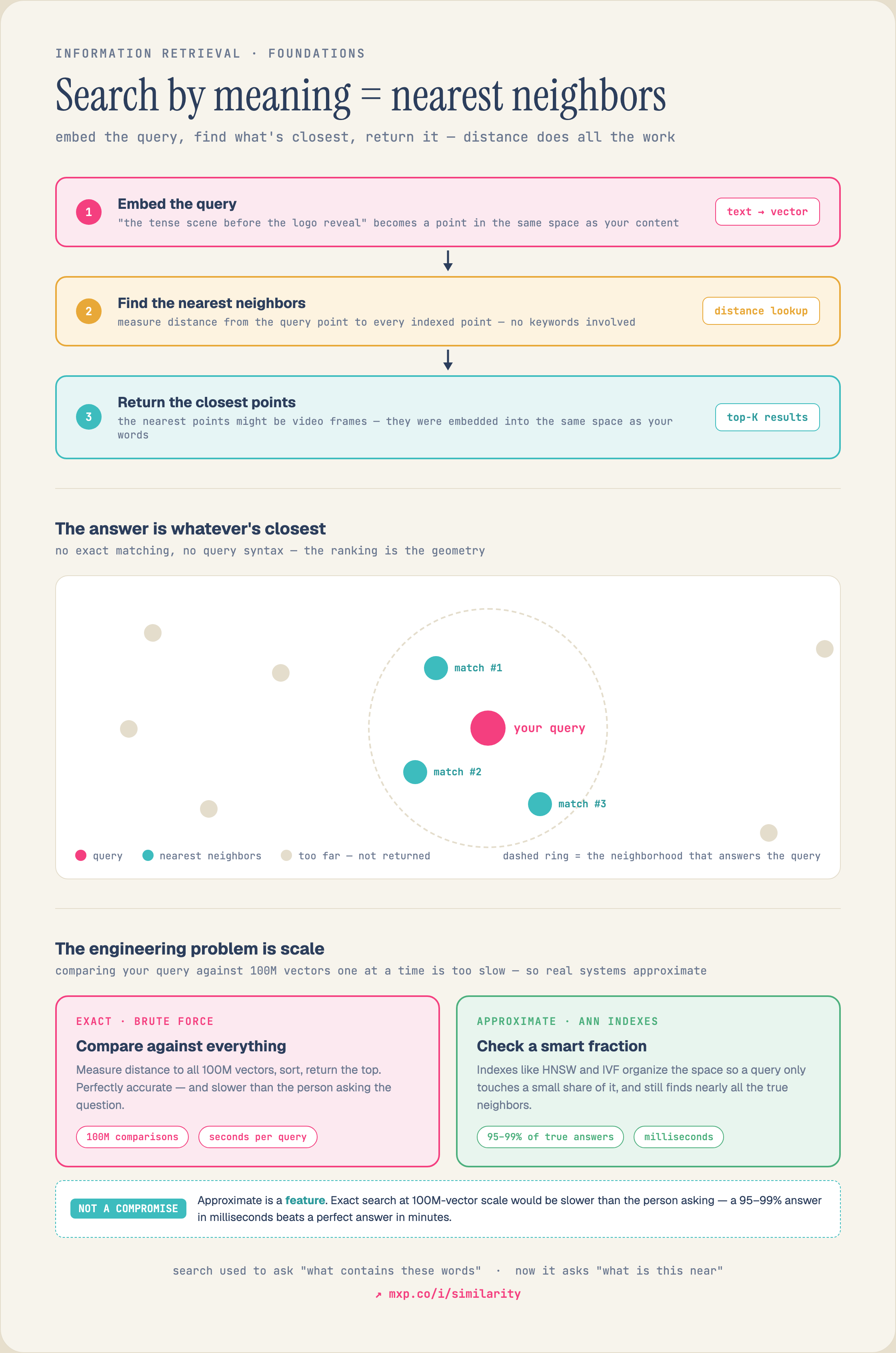
Semantic search encodes both queries and documents into dense vector representations using embedding models, then finds documents whose vectors are most similar to the query vector. This captures synonyms, paraphrases, and conceptual relationships that keyword search misses. The process involves encoding the query, performing approximate nearest neighbor search in a vector index, and ranking results by semantic similarity.
Technical Details
Semantic search uses bi-encoder models (E5, BGE, GTE) to independently embed queries and documents into a shared vector space. Embedding dimensions range from 384 to 1024. Vector indices (HNSW, IVF) enable sub-millisecond search over millions of documents. Cross-encoder rerankers can rescore top results for improved precision. Hybrid approaches combine semantic similarity with keyword matching (BM25) for best overall performance.
Best Practices
- Combine semantic search with keyword search in a hybrid approach for optimal recall and precision
- Use domain-specific embedding models or fine-tune general models on your data
- Apply reranking on top-k results to improve precision at the cost of marginal latency
- Index documents at the appropriate chunk size for your query types (sentences vs paragraphs)
Common Pitfalls
- Relying solely on semantic search for queries requiring exact keyword matching (product IDs, names)
- Using embedding models not trained on your domain, leading to poor semantic capture
- Not chunking long documents, causing important details to be averaged away in embeddings
- Ignoring the importance of query-document length mismatch in asymmetric search scenarios
Advanced Tips
- Use multimodal embedding models (CLIP, CLAP) for cross-modal semantic search across text, images, and audio
- Implement learned sparse representations (SPLADE) alongside dense for hybrid semantic search
- Apply query expansion with LLMs to enrich short queries before embedding
- Use ColBERT-style late interaction for token-level semantic matching with efficient retrieval
Put multimodal search to work
Connect a bucket and Mixpeek runs the whole multimodal search pipeline for you: extraction, indexing, and search over your own objects. No models to wire up, nothing to host.
Start with ManagedAlready have vectors?
Keep your embeddings on your own cloud and run dense, sparse, and BM25 search directly on object storage. From $25/mo.
Start with MVS