The Problem: Most Enterprise Data Is Unstructured
Where those sources disagree on field names, merging sources with different schemas covers reconciling them into one canonical view.
Analysts estimate that 80-90% of enterprise data is unstructured — video, audio, images, PDFs, presentations, and other files that do not fit into rows and columns. Yet the vast majority of data infrastructure assumes structured, tabular data. The result is a massive blind spot: organizations can query their CRM and financial data in seconds, but searching across their video libraries, brand asset repositories, or audio archives requires manual effort or brittle, single-purpose tools.
Vector databases emerged as a partial solution. They store embeddings and enable similarity search. But a vector database is a component, not a system. It handles one step (search over embeddings) while leaving ingestion, decomposition, storage management, and complex retrieval logic to the application developer.
A multimodal data warehouse is the system-level answer. It does for unstructured data what Snowflake and BigQuery did for structured data: provide a single platform that handles the full lifecycle from ingestion to insight.
What Is a Multimodal Data Warehouse?
A multimodal data warehouse is an integrated infrastructure layer that ingests unstructured objects (video, audio, images, documents), decomposes them into queryable features, stores those features across cost-optimized tiers, and reassembles results through composable retrieval pipelines.
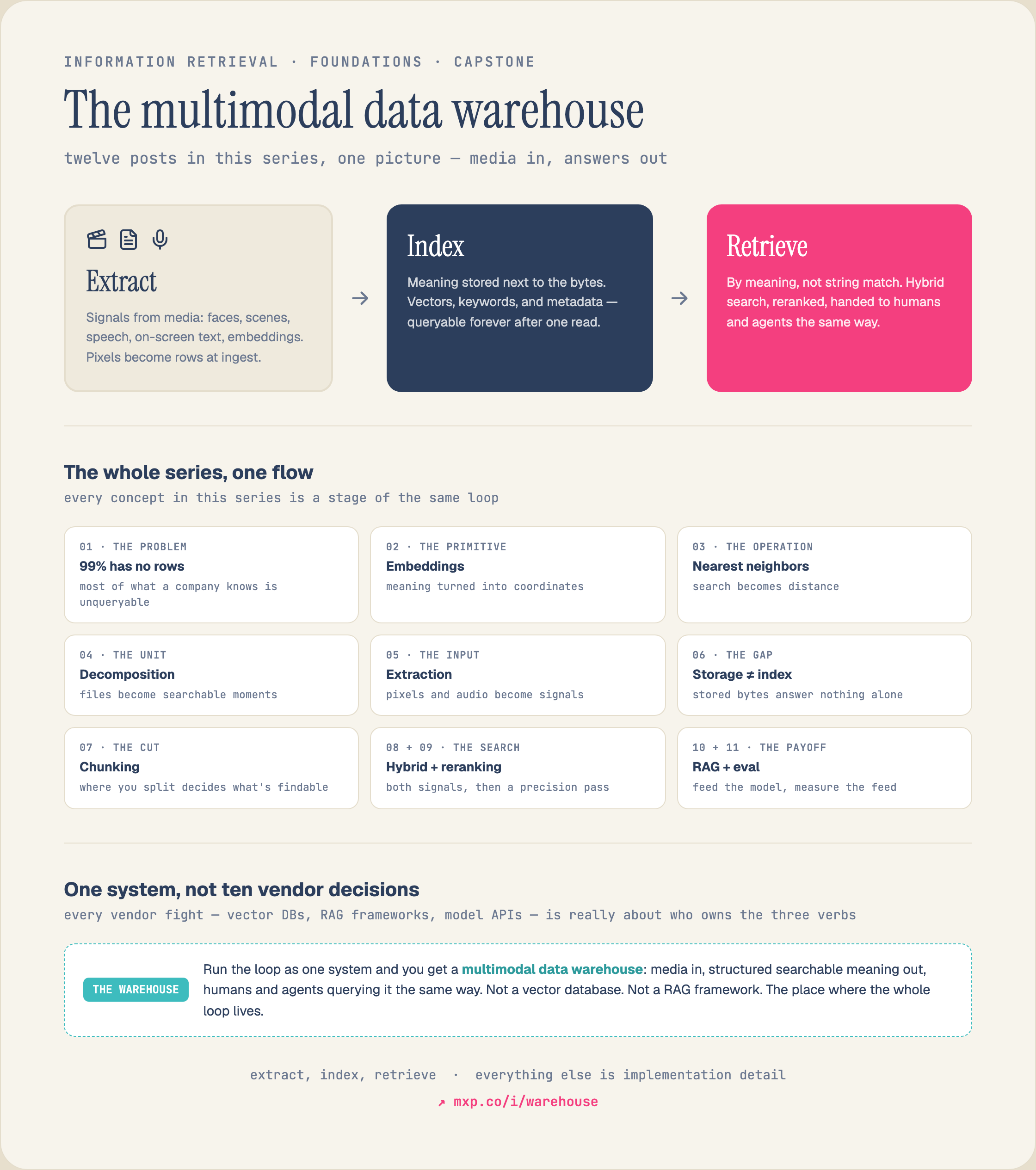
See the full diagram →
The architecture rests on three pillars:
1. Decompose — Break complex objects into their constituent features. A single video becomes dozens of queryable data points: face embeddings, logo detections, audio fingerprints, scene boundaries, text transcripts, and visual embeddings. 2. Store — Persist features across storage tiers optimized for different access patterns and cost profiles. Hot data lives in a vector index for real-time search. Warm data lives in cost-effective vector storage for batch workloads. Cold and archived data is retained for compliance and long-term analysis. 3. Reassemble — Query across features using multi-stage retrieval pipelines that filter, sort, reduce, enrich, and apply transformations — the equivalent of SQL for unstructured data.
Object Decomposition
Object decomposition is the process of extracting structured, queryable features from unstructured objects. This is the fundamental operation that makes unstructured data warehouse-ready.
Consider a 30-second video clip. A multimodal data warehouse decomposes it into:
Each extracted feature is stored with a feature URI that traces back to the source object:
mixpeek://extractor@version/output. This lineage ensures that every search result can be traced back to the exact source frame, timestamp, or audio segment.Learn more about feature extraction on the Mixpeek documentation.
Storage Tiering
Not all data needs to be instantly searchable. A multimodal data warehouse manages features across multiple storage tiers:
Collections transition between tiers automatically based on configurable lifecycle policies. A collection might start in hot storage for its first 30 days, move to warm after 90 days of low query volume, and transition to cold after a year.
Multi-Stage Retrieval
Multi-stage retrieval pipelines are the query language of a multimodal data warehouse. Instead of a single vector similarity search, pipelines compose multiple stages to express complex retrieval logic:
These stages compose into pipelines that express arbitrarily complex retrieval logic while remaining modular and reusable.
Explore retrieval pipelines in the Mixpeek documentation.
The Semantic Join
In structured databases, a JOIN connects rows from different tables using foreign keys. In a multimodal data warehouse, the semantic join connects features from different collections using vector similarity.
For example, you might have:
A semantic join enriches surveillance results with matched employee identities — without any shared keys, schema alignment, or pre-defined relationships. The join is computed at query time based on embedding similarity.
This is implemented as the
document_enrich stage in Mixpeek's retrieval pipelines. It enables cross-collection, cross-modal enrichment that would be impossible in a traditional database.Taxonomies
Taxonomies bring schema-like structure to unstructured data. They classify features and objects into categories, enabling faceted search and structured analytics over inherently unstructured content.
A multimodal data warehouse supports three taxonomy modes:
1. Materialized — Classification happens at ingestion time. Every new object is automatically categorized as it enters the warehouse. Fast at query time, but requires re-ingestion when categories change. 2. On-demand — Classification happens at query time. Useful for exploratory analysis when you do not know the categories in advance. 3. Retroactive — Batch classification over historical data. When your taxonomy evolves, retroactive classification updates historical data without re-ingesting source objects.
Learn more about taxonomies on the Mixpeek documentation.
Why Not Just a Vector Database?
Vector databases are components. They store embeddings and execute similarity search. A multimodal data warehouse is a system that includes vector search as one layer among many:
| Capability | Vector Database | Multimodal Data Warehouse |
| Embedding storage and search | Yes | Yes |
| Object decomposition | No | Yes — 14+ model endpoints |
| Feature extraction | No | Yes — automatic at ingestion |
| Storage tiering | No | Yes — hot/warm/cold/archive |
| Multi-stage retrieval | No | Yes — filter/sort/reduce/enrich/apply |
| Semantic joins | No | Yes — cross-collection enrichment |
| Taxonomies | No | Yes — materialized, on-demand, retroactive |
| Feature lineage | No | Yes — feature URIs with full provenance |
Getting Started with Mixpeek
Mixpeek is the multimodal data warehouse for AI-native applications. It handles object decomposition, tiered storage, and multi-stage retrieval so you can focus on building your application.