Reverse Image Search: Find Visually Similar Images by API
Submit an image, get back the most visually similar matches from your catalog in under 100ms. Powered by vision-language embeddings (CLIP, SigLIP), approximate nearest neighbor search, and a managed infrastructure that scales to hundreds of millions of images.
What is Reverse Image Search?
Instead of typing keywords, you submit an image. The system encodes it into a vector and finds the closest matches in your catalog by visual similarity: no captions, no tags, no manual labeling required.
Pixels, Not Keywords
Vision encoders like CLIP and SigLIP convert pixels directly into embeddings. The system never depends on manually-written alt text or product tags: it sees the image the way the model sees it.
Sub-100ms at Catalog Scale
HNSW or IVF-PQ vector indexes return top-K matches over hundreds of millions of images in single-digit milliseconds. The encoder pass on the query image is the only meaningful latency cost.
Robust to Crops and Edits
Modern vision-language models are trained to be invariant to common transformations. Cropped, rotated, recolored, or watermarked versions of the same image still cluster together in embedding space.
How Reverse Image Search Works
Four phases: index your catalog, encode the query, run vector search, return grounded matches with metadata.
Index Your Images
Upload images (or point to S3/GCS) and the pipeline auto-extracts visual embeddings using SigLIP, CLIP, or your own model. Each image becomes a vector in a searchable index.
Submit a Query Image
A user uploads or pastes an image URL. The same encoder that indexed your catalog encodes the query, producing an embedding in the same space.
Vector Search + Rerank
Approximate nearest neighbor search finds the top-K most visually similar images in milliseconds. An optional cross-encoder rerank step boosts precision before returning results.
Return Grounded Matches
Results come back with image URLs, similarity scores, bounding boxes (optional), and any metadata you stored: ready to render in a product grid, moderation queue, or alert.
Swap encoders without rewriting the pipeline. Start with SigLIP for general-purpose visual similarity, then layer in domain-tuned models or perceptual hashes for specialized lookup tasks.
Reverse Image Search Use Cases
Wherever the source of truth is visual, reverse image search beats keyword search.
E-commerce Visual Discovery
Shoppers upload a photo of something they like; the search returns visually similar products from your catalog. Powers 'shop the look', cross-sell on PDPs, and visual recommendations on mobile.
Brand and IP Protection
Detect unauthorized use of your logos, product photos, or copyrighted images across millions of crawled pages, ad creatives, and user-generated content. Trigger takedowns from match alerts.
Image Deduplication and Lineage
Identify near-duplicate, cropped, or recolored versions of an image across your DAM, content library, or moderation queue. Surface the canonical original and every derivative.
Content Verification and Moderation
Match an inbound image against a known-bad index (CSAM hashes, hate symbols, deepfakes) or a known-good catalog. Block or escalate based on similarity score and metadata.
One Photo In, Twenty Listings Out
Reverse image search also runs as a retriever stage against the open web. One product photo from a 118-image demo catalog came back as 20 ranked retail listings across 13 domains in a single call, with Google Lens as the engine and a four-line stage config.
Google Lens returns visual matches, so the rows are products that look like the query image. To prove a specific file was copied, pair the stage with a hash check.
See the full diagram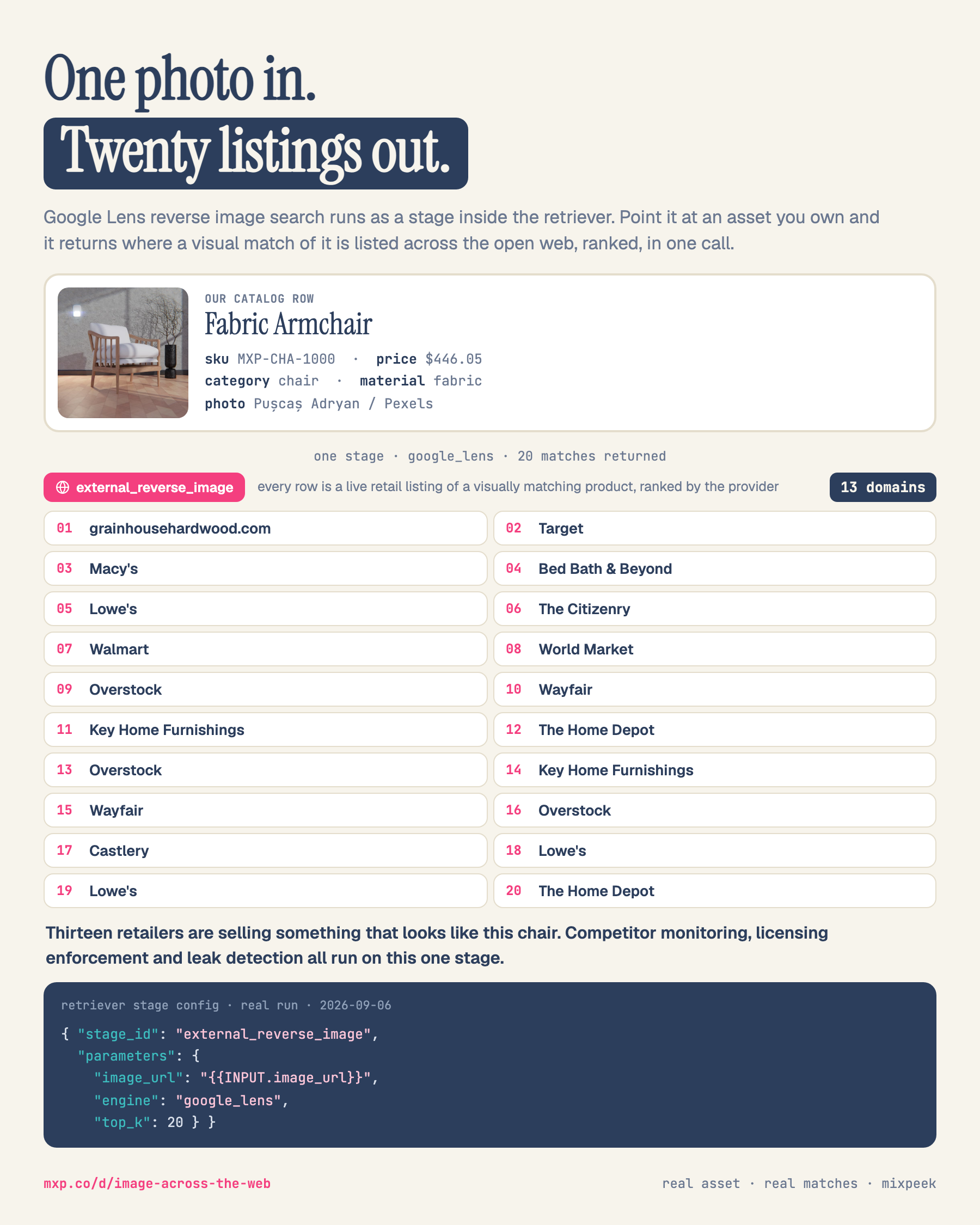
Keyword Search vs. Reverse Image Search
Different inputs, different encoders, different jobs.
| Aspect | Keyword Search | Reverse Image Search |
|---|---|---|
| Input | Text query | Image (upload or URL) |
| Encoder | Text embedding model | Vision encoder (CLIP, SigLIP) |
| What it finds | Documents containing matching words | Visually similar images regardless of caption |
| Best for | Concept search ('red sneakers') | Visual lookup ('this exact sneaker') |
| Handles unlabeled data | No: needs alt text or transcripts | Yes: pixels are the only input |
| Common applications | Site search, FAQ retrieval | Visual shopping, IP detection, dedup |
Build Reverse Image Search
Drop in your image catalog, define a vision-encoder collection, and call a single retriever endpoint.
from mixpeek import Mixpeek

client = Mixpeek(api_key="YOUR_API_KEY")

# 1. Create a namespace for your image catalog
client.namespaces.create(
    namespace_name="product-catalog",
    description="Reverse image search over product photos",
)

# 2. Define a collection that extracts visual embeddings
#    SigLIP / CLIP embeddings: strong baseline for visual similarity.
client.collections.create(
    collection_name="product-images",
    feature_extractors=[
        {"type": "image_embedding", "model": "siglip-large"},
    ],
)

# 3. Upload images to a bucket and trigger processing
client.buckets.upload(
    bucket_name="catalog-photos",
    files=["sneaker_001.jpg", "sneaker_002.jpg", "..."],
    auto_process=True,
)

# 4. Build a reverse image search retriever
retriever = client.retrievers.create(
    retriever_name="reverse_image_search",
    inputs=[{"name": "query_image", "type": "image"}],
    settings={
        "stages": [
            {"type": "feature_search", "method": "vector",
             "modalities": ["image"], "limit": 50},
            {"type": "rerank", "model": "cross-encoder-vision", "limit": 12},
        ]
    },
)

# 5. Search by uploading a query image
results = client.retrievers.execute(
    retriever_id=retriever.retriever_id,
    inputs={"query_image": "https://example.com/user-upload.jpg"},
)

# Each result has the matching image URL, similarity score, and metadata
for doc in results.documents:
    print(doc.preview_url, doc.score, doc.metadata.get("sku"))
Vision Encoders for Reverse Image Search
Pick the encoder that fits your domain. All work as drop-in feature extractors inside Mixpeek.
CLIP
OpenAI's image-text contrastive baseline. Great general-purpose visual similarity.
SigLIP
Google's improved CLIP successor. Higher recall on most retrieval benchmarks.
DINOv2
Self-supervised vision-only encoder from Meta. Strong on fine-grained visual similarity.
Nomic Embed Vision
Open-source vision encoder aligned with text embeddings. Drop-in for cross-modal search.
Perceptual Hash (pHash)
Lightweight hash for exact-copy and near-duplicate detection. Pairs well with vector search.
Custom / Fine-Tuned
Bring your own domain-tuned model: fashion, medical, satellite, satellite imagery, art.
Build this from the docs
The tutorial and stages behind the four phases above, with request shapes and worked examples.
Frequently Asked Questions
What is reverse image search?
Reverse image search lets you find visually similar images by submitting an image as the query, instead of typing text. The system encodes the query image into a vector embedding, then searches a vector index of pre-encoded images to return the closest matches by visual similarity. It powers visual shopping, image lookup, brand-logo detection, and content moderation.
How does reverse image search work?
Three steps: (1) Index, every image in your catalog is encoded by a vision model (CLIP, SigLIP, or a custom encoder) into a high-dimensional vector and stored in a vector database. (2) Query: a user submits an image; the same encoder produces a query vector. (3) Search: approximate nearest neighbor (ANN) algorithms find the most similar vectors in milliseconds, ranked by cosine similarity. An optional cross-encoder rerank step refines the top results.
What's the difference between reverse image search and Google Images?
Google Images runs reverse image search over the public web and is indexed for general consumer lookup. A self-hosted reverse image search system (like Mixpeek) runs over YOUR catalog: product photos, brand assets, moderation databases, or any image collection you control. You choose the encoder, the index, and the metadata returned, and you keep the data inside your infrastructure.
Which embedding models work best for reverse image search?
CLIP and SigLIP are the standard baselines: they produce dense visual embeddings trained on hundreds of millions of image-text pairs and generalize well across domains. SigLIP (Google's improved CLIP successor with sigmoid loss) typically wins on retrieval benchmarks. For domain-specific catalogs (fashion, medical imaging, satellite), fine-tuning or using a domain-trained encoder yields better recall. Mixpeek lets you swap encoders without changing the rest of the pipeline.
How is reverse image search different from reverse video search?
Reverse image search operates on still images: one query image, one set of indexed images, one similarity score per match. Reverse video search adds the temporal dimension: videos are split into segments (by fixed interval, scene change, or shot boundary), each segment is embedded, and a query (video or image) returns the matching frames or clips with timestamps. For a deeper look at the video version, see the full reverse video search guide.
Can reverse image search find cropped, rotated, or recolored versions of an image?
Yes: modern vision encoders are trained to be invariant to many common transformations. CLIP and SigLIP handle moderate cropping, rotation, color shifts, and resolution changes well. For exact-copy detection (cropped logos, watermark removal, screen captures), pair the visual embedding with a perceptual hash (pHash) or a dedicated copy-detection model.
How fast is reverse image search at scale?
Production reverse image search returns top-K matches in under 100ms even over indexes of hundreds of millions of images. The bottleneck is usually the encoder pass over the query image (about 30-50ms on a GPU), not the vector search itself, which is sub-10ms with HNSW or IVF-PQ indexes. Mixpeek runs encoders and vector search on managed infrastructure that auto-scales.
What metadata can I attach to indexed images?
Anything you want: SKU, category, tags, source URL, upload timestamp, brand, license, bounding boxes from object detection. Metadata travels alongside the embedding and comes back with each search result, so you can filter (e.g., 'find similar sneakers in size 10') or build hybrid search that combines visual similarity with structured filters.
How does Mixpeek support reverse image search?
Mixpeek is a multimodal data warehouse: ingest images via bucket upload, define a collection with a vision-encoder feature extractor, build a retriever pipeline that combines vector search + filters + rerank, and call a single API to return matching images with metadata. You don't manage GPUs, vector databases, or model serving: and the same infrastructure scales to videos, PDFs, and audio.
Can reverse image search be combined with text search?
Yes: this is called hybrid or cross-modal search. Because vision-language encoders like CLIP and SigLIP map images and text into a shared embedding space, you can submit either an image or a text query and search the same index. Mixpeek lets you compose hybrid retrievers that fuse text and image queries with reciprocal rank fusion, so users can search 'red sneakers' or upload a photo and get the same kind of results.
Build Reverse Image Search on Your Catalog
Stop relying on alt text and tags. Index your images with a vision encoder, search by visual similarity, and ship visual lookup, brand protection, and content moderation in one pipeline.
Searching PDFs and scanned documents instead? Visual document retrieval searches pages as images: no OCR pipeline required.