Video Moderation Extraction Foundation
Segment a video corpus, extract a keyframe record for every segment, and match brand marks against a reference set you upload. Face and public-figure matching run on a dedicated or customer-hosted deployment. This deploy is the extraction layer a moderation policy sits on, and the page carries a state on every part so you can see which policy pieces are yours to add.
One click deploys the extraction layer: segments you can search in plain text, keyframes, and a brand-mark reference index with the retriever that searches it.
Teams preparing video corpora for model training who have to show a regulator, a customer or a court what was excluded and why. The problem shows up at ingest, where the corpus is largest and the cost of getting it wrong compounds through every downstream run.
What deploys today7 ready1 not yet proven3 need your input13 not available yetStudio will also guide you to Brand Logo Match for zero-setup evaluation, then to a continuous data connection for production.
What deploys today
What each part needs
The states are read from the manifest, so a part it ships commented out never shows as ready.
- video-segments
- Deploys and processes documents as they arrive.
- brand-mark-index
- Deploys and processes documents as they arrive.
- keyframes
- Deploys and processes documents as they arrive.
- brand-mark-match
- Deploys and answers queries once its collections hold documents.
- segment-search
- Deploys and answers queries once its collections hold documents.
- flagged-segment-monitor
- Deploys and answers queries once its collections hold documents.
- group_by stage
- The one-click manifest includes this stage.
- roll-up-by-segment
- Deploys, and part of what feeds it is not ready: person-verdicts, violence-context and onscreen-text. Results cover only the parts that are.
- source-video
- Create the s3 credentials as manifest secrets, then uncomment the sync. It ships commented out because apply tests a connection as it creates it.
- brand-marks
- You upload these files yourself. There is no connection to sync.
- person-references
- You upload these files yourself. There is no connection to sync.
- person-ref-index
- Face recognition is turned off on Mixpeek Cloud, so this face step does not deploy. It runs on a dedicated or customer-hosted deployment, where face_identity_extractor is served.
- faces
- Face recognition is turned off on Mixpeek Cloud, so this face step does not deploy. It runs on a dedicated or customer-hosted deployment, where face_identity_extractor is served.
- onscreen-text
- scrolling_text_extractor@v1 declares expected_input_types {video: video}, and a collection-to-collection chain hands it video_segment_url, which the platform types as STRING. POST /v1/manifest/apply rejects the pair and rolls the whole manifest back. face_identity_extractor@v1 takes the same mapping and applies, because it declares no expected_input_types. Tracked with backend; remove this line when the chain accepts a URL string for a typed video input.
- age-estimation
- No age_estimator extractor is published to install yet, and it reads the face crops that face recognition would produce, which is off on Mixpeek Cloud.
- violence-context
- No context_scorer extractor is published to install yet, so this step has nothing to run.
- public-figure-match
- Face recognition is turned off on Mixpeek Cloud, so this face step does not deploy. It runs on a dedicated or customer-hosted deployment, where face_identity_extractor is served.
- person-rollup
- A cluster trigger's output_collections redirects a run into a collection this manifest also declares, and the reference graph validates. The destination never receives the cluster output vector index: that index is installed by the cluster CREATE path (api/clusters/services.py::_create_output_collection), and api/triggers/executor.py dispatches the run straight to the queue without it, so the output points are dropped at upsert and the collection stays empty. Tracked with backend; remove this line when a redirected destination gets the index.
- segment-rollup
- A cluster trigger's output_collections redirects a run into a collection this manifest also declares, and the reference graph validates. The destination never receives the cluster output vector index: that index is installed by the cluster CREATE path (api/clusters/services.py::_create_output_collection), and api/triggers/executor.py dispatches the run straight to the queue without it, so the output points are dropped at upsert and the collection stays empty. Tracked with backend; remove this line when a redirected destination gets the index.
- person-verdicts
- No retriever can write a collection yet, so this deploys as an empty placeholder that nothing fills.
- segment-verdicts
- No retriever can write a collection yet, so this deploys as an empty placeholder that nothing fills.
- review-queue
- Deploys, but everything it reads comes from segment-verdicts, which is not available yet, so it returns nothing.
- moderation-search
- Deploys, but everything it reads comes from segment-verdicts, which is not available yet, so it returns nothing.
- cleared-set-export
- Deploys, but everything it reads comes from segment-verdicts, which is not available yet, so it returns nothing.
What it looks like
Pick a frame or a search and see what fires.
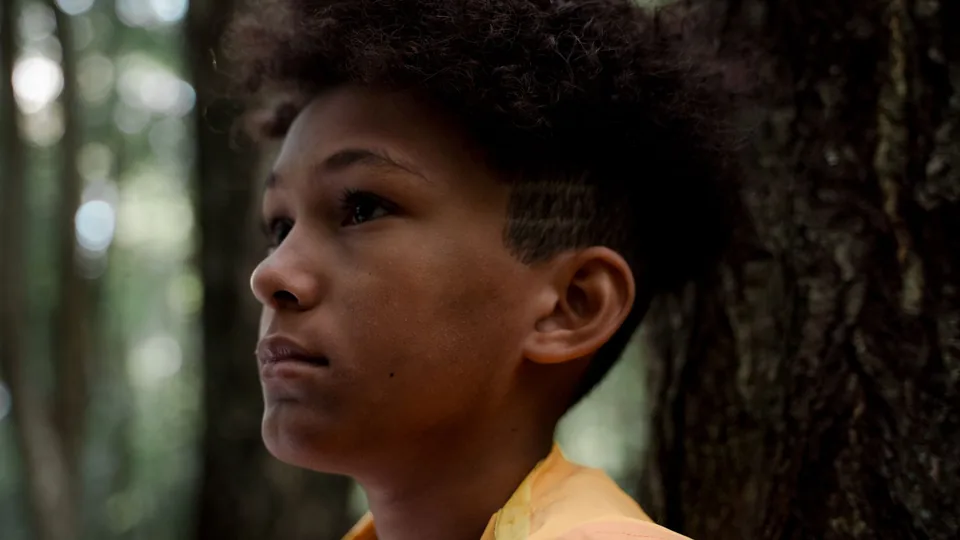 review
- face detected 0.93
- grouped across 3 looks
- age estimate: borderline
- route: review
face 0.93 · est. 16 to 18 · borderlinereview brand mark · match 0.88 · rule: contextualcleared
 staged 0.81 · real 0.19 · margin +0.62cleared
 onscreen_text · BREAKING NEWS · staticcleared
What you would ask it
Example searches this namespace answers once it is applied. Each one names the retriever that serves it.
“segments with a visible brand mark”
brand-mark-match
keyframes matched against your own reference index
“everything still waiting on a human decision”
review-queue
the borderline set, with the reason each one landed there
“the cleared set, ready to train on”
cleared-set-export
only what passed, once the verdict steps apply; empty before that
How the namespace is wired
The diagram shows 3 buckets, 8 collections, 2 clean views and 8 retrievers. The manifest below applies 3 buckets, 4 collections (clean views included) and 7 retrievers today; the other parts are commented out in it, each with the reason. The diagram generates the manifest, so they cannot drift apart.
Reward signals
How reviewer decisions move the thresholds
Thresholds at ingest drift as the corpus changes. The reviewers working the queue are the ones who see where a threshold is wrong first, so this template routes their decisions back into the model that set it.
A reviewer marks a verdict right or wrong and attaches what they saw. That is an annotation, written with POST /v1/annotations, versioned, and stored in the namespace's own mxp_document_annotations collection.
What a reviewer opens, skips, or acts on is an interaction, written with POST /v1/retrievers/interactions into mxp_retriever_interactions. Nobody fills in a form for these.
mxp_document_annotationsmxp_retriever_interactionsmxp_retriever_evaluationsSystem collections in your namespace, on the same vector store as the rest of the template. They are yours to query.
POST /v1/retrievers/{id}/evaluations/generate-from-interactions turns those signals into an evaluation set, so a threshold change is judged by precision and recall moving on held-out data rather than by whether signals were captured. moderation-search is configured with learned fusion in shadow mode: it learns from the signals and reports what it would have ranked, and you flip it on with a retriever PATCH when the numbers justify it.
One file spins up the namespace. Generated from the diagram above. Also served at /templates/video-moderation.namespace.yaml.
# video-moderation: one manifest spins up the namespace.
# Platform manifest schema (GET /v1/discovery/schema). Validate with POST /v1/manifest/validate,
# apply with POST /v1/manifest/apply or the Deploy button. Wiring comes from the flow diagram:
# edges are bucket -> collection sources, collection -> retriever scope, retriever -> view.
# Applying a SECOND time, over a namespace this template already created: use
# POST /v1/manifest/apply?mode=create_missing, which creates what is missing and leaves
# what exists alone. The default, create_only, fails the WHOLE apply and rolls it back if
# any resource already exists, so an upgrade looks like a dead end without this. Use
# mode=upsert to also patch resources that exist but have drifted from this file.
version: '1.0'
metadata:
  name: video-moderation
  description: "Namespace template video-moderation. Generated from the flow diagram on mixpeek.com/templates/video-moderation."
namespaces:
  - name: video-moderation
    description: "Everything below lives in this namespace."
    feature_extractors:
      - name: multimodal_extractor
        version: v2
      - name: image_extractor
        version: v1
      - name: passthrough_extractor
        version: v1
    # Daily spend budget, in dollars of what you are charged (1,000 credits a dollar).
    # New batches pause once the namespace has spent this much today; queries are not capped.
    # Raise it later on the namespace: PATCH /v1/namespaces/<id> {"spend_budget": {"daily_usd": N}}.
    budget:
      daily_usd: 1

# Data sources. A storage connection carries credentials, so it is created in Studio
# (or POST /v1/organizations/storage-connections) and synced into the bucket named here.
#   source-video: s3, continuous, your footage, in your account -> bucket source-video
#   brand-marks: manual, one-shot, customer-supplied logo and mark variants -> bucket brand-mark-refs
#   person-references: manual, one-shot, customer-supplied public-figure reference imagery -> bucket person-refs
buckets:
  - name: source-video
    namespace: video-moderation
    description: "Meant to be fed by source-video (s3, continuous). No source is connected yet: applying this manifest creates the bucket only. Connect the source to this bucket in Studio (Syncs) to start the feed."
    schema:
      properties:
        content:
          type: video
  - name: brand-mark-refs
    namespace: video-moderation
    description: "Meant to be fed by brand-marks (manual, one-shot): upload files here or write them through the API. Nothing arrives until you do."
    schema:
      properties:
        content:
          type: image
    # Starts empty and is yours to fill. Until it has files, screen against the hosted
    # set instead: 189,830 brand marks from LogoDet-3K, OpenLogo, OSLD, Logos-in-the-Wild and the ESPN team sets
    #   curl -X POST https://api.mixpeek.com/v1/marketplace/catalog/brand-logo-match/execute \
    #     -H 'Content-Type: application/json' \
    #     -d '{"inputs":{"query":"<image url>"},"pagination":{"method":"offset","page_number":1,"page_size":10}}'
    # No key and no subscription. https://mixpeek.com/marketplace/brand-logo-match
  - name: person-refs
    namespace: video-moderation
    description: "Meant to be fed by person-references (manual, one-shot): upload files here or write them through the API. Nothing arrives until you do."
    schema:
      properties:
        content:
          type: image
    # Starts empty and is yours to fill. Until it has files, screen against the hosted
    # set instead: 32,667 public-figure faces from LFW, FaceScrub, Wikipedia and the 2025 NFL, NBA, MLB, NHL, NCAA and Premier League rosters
    #   curl -X POST https://api.mixpeek.com/v1/marketplace/catalog/celebrity-face-match/execute \
    #     -H 'Content-Type: application/json' \
    #     -d '{"inputs":{"query":"<image url>"},"pagination":{"method":"offset","page_number":1,"page_size":10}}'
    # No key and no subscription. https://mixpeek.com/marketplace/celebrity-face-match

# Connect your own storage. Create the two secrets, uncomment, and apply again;
# apply live-tests the connection, so it must have real credentials to succeed.
# Until then the buckets above accept direct uploads.
# storage_connections:
#   - name: source-video-connection
#     provider: s3
#     description: "Read-only access to the s3 location holding your footage, in your account."
#     config:
#       region: us-east-1
#       credentials:
#         type: access_key
#         access_key_id: ${{ secrets.AWS_ACCESS_KEY_ID }}
#         secret_access_key: ${{ secrets.AWS_SECRET_ACCESS_KEY }}

# bucket_syncs:
#   - name: source-video-sync
#     bucket: source-video
#     connection: source-video-connection
#     source_path: "footage/"
#     sync_mode: continuous
#     polling_interval_seconds: 300
#     skip_duplicates: true
#     file_filters:
#       include_patterns: ["*.mp4", "*.mov", "*.mkv", "*.webm"]
#     schema_mapping:
#       mappings:
#         content:
#           target_type: blob
#           source: {type: file}
#           blob_type: video

collections:
  - name: video-segments
    namespace: video-moderation
    description: "multimodal_extractor@v2 over bucket source-video. Feeds flagged-segment-monitor, flagged-segment, faces, keyframes, onscreen-text, segment-rollup, roll-up-by-segment, segment-search."
    source:
      type: bucket
      bucket: source-video
    feature_extractor:
      name: multimodal_extractor
      version: v2
      parameters:
        run_transcription: true
        run_transcription_embedding: true
        run_ocr: true
        run_ocr_embedding: true
      input_mappings:
        video: content
      field_passthrough:
        - source_path: file_location
        - source_path: segment_id
        - source_path: start_time
        - source_path: end_time
    alert_applications:
      - alert: flagged-segment
        input_mappings:
          - input_key: query
            source: {source_type: constant, value: "nudity, violence or a weapon"}
          - input_key: document_id
            source: {source_type: document_field, path: _internal.document_id}
    enabled: true
  - name: brand-mark-index
    namespace: video-moderation
    description: "image_extractor@v1 over bucket brand-mark-refs. Feeds brand-mark-match."
    source:
      type: bucket
      bucket: brand-mark-refs
    feature_extractor:
      name: image_extractor
      version: v1
      input_mappings:
        image: content
      field_passthrough:
        - source_path: mark_name
        - source_path: rule
    enabled: true
  - name: keyframes
    namespace: video-moderation
    description: "image_extractor@v1 over collection video-segments. Feeds violence-context."
    source:
      type: collection
      collection: video-segments
    feature_extractor:
      name: image_extractor
      version: v1
      input_mappings:
        image: thumbnail_url
      field_passthrough:
        - source_path: thumbnail_url
        - source_path: segment_id
        - source_path: frame_ts
    enabled: true

# NOT APPLIED. Every collection person-verdicts derives from (faces, age-estimation) is commented out in this
# manifest, so it has no source to be created from. It applies once one of them does.
#   - name: person-verdicts
#     namespace: video-moderation
#     description: "Cluster person-rollup is the intended producer and is emitted commented out below, so nothing writes here yet. One document per person_id. Writes back n_looks. Declared as a passthrough collection so the retrievers that name it still resolve; read what they return as source rows, not as this view's output. age_median and aged wait on the age-estimation block above."
#     source:
#       type: none
#     feature_extractor:
#       name: passthrough_extractor
#       version: v1
#       field_passthrough: []
#     enabled: true
  - name: segment-verdicts
    namespace: video-moderation
    description: "Cluster segment-rollup is the intended producer and is emitted commented out below. Until it applies, this collection holds a plain copy of video-segments's rows, with none of the fields this view describes. One document per segment_id. Writes back n_person. Declared as a passthrough collection so the retrievers that name it still resolve; read what they return as source rows, not as this view's output. decision, reason, n_minor and n_unaged wait on the age-estimation block above, n_borderline on violence-context."
    source:
      type: collection
      collection: video-segments
    feature_extractor:
      name: passthrough_extractor
      version: v1
      field_passthrough: []
    enabled: true

# NOT APPLIED. Face recognition is turned off on Mixpeek Cloud, so this face step does not deploy. It runs on a dedicated or customer-hosted deployment, where face_identity_extractor is served.
# The block below is correct and is emitted commented out so the rest of this
# manifest applies; an apply is all-or-nothing and would otherwise roll back.
#   - name: person-ref-index
#     namespace: video-moderation
#     description: "face_identity_extractor@v1 over bucket person-refs. Feeds public-figure-match."
#     source:
#       type: bucket
#       bucket: person-refs
#     feature_extractor:
#       name: face_identity_extractor
#       version: v1
#       input_mappings:
#         image: content
#       field_passthrough:
#         - source_path: person_name
#         - source_path: rights_note
#     enabled: true

# NOT APPLIED. Face recognition is turned off on Mixpeek Cloud, so this face step does not deploy. It runs on a dedicated or customer-hosted deployment, where face_identity_extractor is served.
# The block below is correct and is emitted commented out so the rest of this
# manifest applies; an apply is all-or-nothing and would otherwise roll back.
#   - name: faces
#     namespace: video-moderation
#     description: "face_identity_extractor@v1 over collection video-segments. Feeds age-estimation, person-rollup, segment-rollup."
#     source:
#       type: collection
#       collection: video-segments
#     feature_extractor:
#       name: face_identity_extractor
#       version: v1
#       input_mappings:
#         video: video_segment_url
#       field_passthrough:
#         - source_path: segment_id
#         - source_path: bbox
#         - source_path: detection_score
#         - source_path: quality_score
#     enabled: true

# NOT APPLIED. scrolling_text_extractor@v1 declares expected_input_types {video: video}, and a collection-to-collection chain hands it video_segment_url, which the platform types as STRING. POST /v1/manifest/apply rejects the pair and rolls the whole manifest back. face_identity_extractor@v1 takes the same mapping and applies, because it declares no expected_input_types. Tracked with backend; remove this line when the chain accepts a URL string for a typed video input.
# The block below is correct and is emitted commented out so the rest of this
# manifest applies; an apply is all-or-nothing and would otherwise roll back.
#   - name: onscreen-text
#     namespace: video-moderation
#     description: "scrolling_text_extractor@v1 over collection video-segments. Feeds roll-up-by-segment."
#     source:
#       type: collection
#       collection: video-segments
#     feature_extractor:
#       name: scrolling_text_extractor
#       version: v1
#       input_mappings:
#         video: video_segment_url
#       field_passthrough:
#         - source_path: segment_id
#     enabled: true

# NOT APPLIED. No age_estimator extractor is published to install yet, and it reads the face crops that face recognition would produce, which is off on Mixpeek Cloud.
# The block below is correct and is emitted commented out so the rest of this
# manifest applies; an apply is all-or-nothing and would otherwise roll back.
#   - name: age-estimation
#     namespace: video-moderation
#     description: "age_estimator@v1 over collection faces. Feeds person-rollup. age_estimator is a template-provided extractor (a plugin that ships with this template, not a hosted one): install it, then apply this block."
#     source:
#       type: collection
#       collection: faces
#     feature_extractor:
#       name: age_estimator
#       version: v1
#       input_mappings:
#         face: face_crop_url
#       field_passthrough:
#         - source_path: person_id
#         - source_path: age_median
#         - source_path: aged
#         - source_path: n_looks
#     enabled: true

# NOT APPLIED. No context_scorer extractor is published to install yet, so this step has nothing to run.
# The block below is correct and is emitted commented out so the rest of this
# manifest applies; an apply is all-or-nothing and would otherwise roll back.
#   - name: violence-context
#     namespace: video-moderation
#     description: "context_scorer@v1 over collection keyframes. Feeds roll-up-by-segment. context_scorer is a template-provided extractor (a plugin that ships with this template, not a hosted one): install it, then apply this block."
#     source:
#       type: collection
#       collection: keyframes
#     feature_extractor:
#       name: context_scorer
#       version: v1
#       input_mappings:
#         image: thumbnail_url
#       field_passthrough:
#         - source_path: segment_id
#         - source_path: staged_score
#         - source_path: real_score
#         - source_path: margin
#     enabled: true
retrievers:
  - name: brand-mark-match
    namespace: video-moderation
    description: "Searches brand-mark-index across 1 feature index."
    collections:
      - brand-mark-index
    input_schema:
      query:
        type: text
        required: true
        description: "What to look for; searched across every index below"
    stages:
      - stage_name: search
        stage_id: feature_search
        parameters:
          searches:
            - feature_uri: "mixpeek://image_extractor@v1/google_siglip_base_v1"
              query:
                input_mode: text
                value: "{{INPUT.query}}"
              top_k: 5
          fusion: rrf
          final_top_k: 5
    tags:
      - template:video-moderation
  # NOT APPLIED. Face recognition is turned off on Mixpeek Cloud, so this face step does not deploy. It runs on a dedicated or customer-hosted deployment, where face_identity_extractor is served.
  # - name: public-figure-match
  #   namespace: video-moderation
  #   description: "Searches person-ref-index across 1 feature index."
  #   collections:
  #     - person-ref-index
  #   input_schema:
  #     query:
  #       type: text
  #       required: true
  #       description: "URL of the image or frame to match; encoded by the index below and compared against it"
  #   stages:
  #     - stage_name: search
  #       stage_id: feature_search
  #       parameters:
  #         searches:
  #           - feature_uri: "mixpeek://face_identity_extractor@v1/insightface__arcface"
  #             query:
  #               input_mode: content
  #               value: "{{INPUT.query}}"
  #             top_k: 5
  #         fusion: rrf
  #         final_top_k: 5
  #   tags:
  #     - template:video-moderation
  - name: roll-up-by-segment
    namespace: video-moderation
    description: "Pipeline retriever over video-segments. Groups documents by segment_id."
    collections:
      - video-segments
      # - person-verdicts  (add once its commented-out block above applies)
      # - violence-context  (add once context_scorer is installed and its block above is applied)
      # - onscreen-text  (add once its commented-out block above applies)
    input_schema:
      limit:
        type: text
        required: false
        description: "Optional cap on documents grouped per run"
    stages:
      - stage_name: source
        stage_id: attribute_filter
        parameters:
          field: segment_id
          operator: exists
          value: true
      - stage_name: group
        stage_id: group_by
        parameters:
          group_by_field: segment_id
    tags:
      - template:video-moderation
  - name: segment-search
    namespace: video-moderation
    description: "Plain-text search over every segment of your footage, the foundation's own entry point: describe what is on screen and get the segments back with their source."
    collections:
      - video-segments
    input_schema:
      query:
        type: text
        required: true
        description: "What to look for; searched across every index below"
    stages:
      - stage_name: search
        stage_id: feature_search
        parameters:
          searches:
            - feature_uri: "mixpeek://multimodal_extractor@v2/gemini-embedding-2"
              query:
                input_mode: text
                value: "{{INPUT.query}}"
              top_k: 20
          fusion: rrf
          final_top_k: 20
    tags:
      - template:video-moderation
  - name: review-queue
    namespace: video-moderation
    description: "Searches segment-verdicts across 1 feature index."
    collections:
      - segment-verdicts
    input_schema:
      query:
        type: text
        required: true
        description: "What to look for; searched across every index below"
    stages:
      - stage_name: search
        stage_id: feature_search
        parameters:
          searches:
            - feature_uri: "mixpeek://multimodal_extractor@v2/gemini-embedding-2"
              query:
                input_mode: text
                value: "{{INPUT.query}}"
              top_k: 100
          fusion: rrf
          final_top_k: 100
    tags:
      - template:video-moderation
  - name: moderation-search
    namespace: video-moderation
    description: "Searches segment-verdicts across 3 feature indexes with learned fusion."
    collections:
      - segment-verdicts
    input_schema:
      query:
        type: text
        required: true
        description: "What to look for; searched across every index below"
      session_id:
        type: text
        required: false
        description: "Session identifier; the learned fusion uses it as personal context"
    stages:
      - stage_name: search
        stage_id: feature_search
        parameters:
          searches:
            - feature_uri: "mixpeek://multimodal_extractor@v2/gemini-embedding-2"
              query:
                input_mode: text
                value: "{{INPUT.query}}"
              top_k: 25
            - feature_uri: "mixpeek://multimodal_extractor@v2/multilingual_e5_large_instruct_v1"
              query:
                input_mode: text
                value: "{{INPUT.query}}"
              top_k: 25
            - feature_uri: "mixpeek://multimodal_extractor@v2/multilingual_e5_large_instruct_ocr_v1"
              query:
                input_mode: text
                value: "{{INPUT.query}}"
              top_k: 25
          fusion: learned
          final_top_k: 25
          # Shadow first: weights are learned and logged, static fusion is served, until the
          # signals justify a rollout. Flip rollout_pct through the retriever update path.
          learning_config:
            shadow_mode: true
            rollout_pct: 0.0
            context_features:
              - INPUT.session_id
    tags:
      - template:video-moderation
  - name: cleared-set-export
    namespace: video-moderation
    description: "Searches segment-verdicts across 1 feature index."
    collections:
      - segment-verdicts
    input_schema:
      query:
        type: text
        required: true
        description: "What to look for; searched across every index below"
    stages:
      - stage_name: search
        stage_id: feature_search
        parameters:
          searches:
            - feature_uri: "mixpeek://multimodal_extractor@v2/gemini-embedding-2"
              query:
                input_mode: text
                value: "{{INPUT.query}}"
              top_k: 500
          fusion: rrf
          final_top_k: 500
    tags:
      - template:video-moderation
  - name: flagged-segment-monitor
    namespace: video-moderation
    description: "The alert's check: does the segment just written show nudity, violence or a weapon. The search is scoped to that one segment, so earlier footage is never re-reported, and an llm_filter watches the segment and keeps it only when it does. Materialises into flagged-segment."
    collections:
      - video-segments
    input_schema:
      query:
        type: text
        required: true
        description: "What to look for; searched across every index below"
      document_id:
        type: text
        required: true
        description: "The written document this run is scoped to, supplied by the alert attachment"
    stages:
      - stage_name: search
        stage_id: feature_search
        pre_filters:
          AND:
            - field: _internal.document_id
              operator: eq
              value: "{{INPUT.document_id}}"
        parameters:
          searches:
            - feature_uri: "mixpeek://multimodal_extractor@v2/gemini-embedding-2"
              query:
                input_mode: text
                value: "{{INPUT.query}}"
              top_k: 5
          fusion: rrf
          final_top_k: 5
      - stage_name: judge
        stage_id: llm_filter
        parameters:
          criteria: "Keep this video segment only if it shows {{INPUT.query}}. Judge what is on screen and in the audio, not the file name or metadata. Discard it otherwise."
          include_media: true
    tags:
      - template:video-moderation
# clusters:

# NOT APPLIED. A cluster trigger's output_collections redirects a run into a collection this manifest also declares, and the reference graph validates. The destination never receives the cluster output vector index: that index is installed by the cluster CREATE path (api/clusters/services.py::_create_output_collection), and api/triggers/executor.py dispatches the run straight to the queue without it, so the output points are dropped at upsert and the collection stays empty. Tracked with backend; remove this line when a redirected destination gets the index.
#   - name: person-rollup
#     namespace: video-moderation
#     description: "Groups the faces collection into one cluster per person, on the ArcFace embedding face_identity_extractor writes. Feeds person-verdicts."
#     # faces also feeds this cluster and is NOT named below: it is emitted
#     # commented out above, so naming it here would fail the whole apply. Add it
#     # to source_collections once that block is applied.
#     # age-estimation also feeds this cluster and is NOT named below: it is emitted
#     # commented out above, so naming it here would fail the whole apply. Add it
#     # to source_collections once that block is applied.
#     source_collections:
#       []  # a composite run reads centroids from the executions named below
#     cluster_type: vector
#     vector_config:
#       feature_uris:
#         - mixpeek://face_identity_extractor@v1/insightface__arcface
#       clustering_method: hdbscan
#       face_cluster_merge:
#         enabled: true
#         centroid_cosine_threshold: 0.55
#         bbox_field: bbox
#         frame_field: frame_number
#         scene_field: segment_id
#     llm_labeling:
#       enabled: true
#       provider: google
#       model_name: gemini-2.5-flash
#     enrich_source_collection: true
#     source_enrichment_config:
#       field_mappings:
#         - source_field: cluster_id
#           target_field: person_id
#         - source_field: cluster_label
#           target_field: person_label

# NOT APPLIED. A cluster trigger's output_collections redirects a run into a collection this manifest also declares, and the reference graph validates. The destination never receives the cluster output vector index: that index is installed by the cluster CREATE path (api/clusters/services.py::_create_output_collection), and api/triggers/executor.py dispatches the run straight to the queue without it, so the output points are dropped at upsert and the collection stays empty. Tracked with backend; remove this line when a redirected destination gets the index.
#   - name: segment-rollup
#     namespace: video-moderation
#     description: "Groups faces and video-segments by segment_id, one cluster per segment. Feeds segment-verdicts. Runs after person-rollup, which is what puts person_id on a face."
#     # faces also feeds this cluster and is NOT named below: it is emitted
#     # commented out above, so naming it here would fail the whole apply. Add it
#     # to source_collections once that block is applied.
#     source_collections:
#       - video-segments
#     cluster_type: attribute
#     attribute_config:
#       attributes:
#         - segment_id
#     llm_labeling:
#       enabled: true
#       provider: google
#       model_name: gemini-2.5-flash
alerts:
  - name: flagged-segment
    namespace: video-moderation
    description: "Emails the org notifications address (Settings -> Notifications; unset means opted out) when a newly written segment looks like nudity, violence or a weapon, so it reaches review without anyone searching for it."
    source: retriever
    retriever: flagged-segment-monitor
    trigger_on: results
    notification_config:
      channels:
        - channel_type: email
      include_matches: true
      include_scores: true
    enabled: false
# triggers:

# NOT APPLIED. A cluster trigger's output_collections redirects a run into a collection this manifest also declares, and the reference graph validates. The destination never receives the cluster output vector index: that index is installed by the cluster CREATE path (api/clusters/services.py::_create_output_collection), and api/triggers/executor.py dispatches the run straight to the queue without it, so the output points are dropped at upsert and the collection stays empty. Tracked with backend; remove this line when a redirected destination gets the index.
#   - name: person-rollup-nightly
#     namespace: video-moderation
#     description: "Runs person-rollup nightly and lands the result in person-verdicts."
#     action_type: cluster
#     trigger_type: cron
#     schedule_config:
#       cron_expression: "0 2 * * *"
#       timezone: UTC
#     action_config:
#       cluster: person-rollup
#       output_collections:
#         - person-verdicts
#     status: active

# NOT APPLIED. A cluster trigger's output_collections redirects a run into a collection this manifest also declares, and the reference graph validates. The destination never receives the cluster output vector index: that index is installed by the cluster CREATE path (api/clusters/services.py::_create_output_collection), and api/triggers/executor.py dispatches the run straight to the queue without it, so the output points are dropped at upsert and the collection stays empty. Tracked with backend; remove this line when a redirected destination gets the index.
#   - name: segment-rollup-nightly
#     namespace: video-moderation
#     description: "Runs segment-rollup nightly and lands the result in segment-verdicts. An hour after person-rollup, since it reads what that run writes."
#     action_type: cluster
#     trigger_type: cron
#     schedule_config:
#       cron_expression: "0 3 * * *"
#       timezone: UTC
#     action_config:
#       cluster: segment-rollup
#       output_collections:
#         - segment-verdicts
#     status: active

# Plan 11.14: two public-domain films to moderate and two CC0 photographs as
# brand-mark references, ingested after apply, and the use case they must
# satisfy.
seed:
  - bucket: source-video
    max_objects: 2
    objects:
      - blobs: {content: samples/starter/videos/norelco-speed.mp4}
      - blobs: {content: samples/starter/videos/mexican-hat-dance.mp4}
  - bucket: brand-mark-refs
    max_objects: 2
    objects:
      - blobs: {content: samples/starter/images/mustang-san-francisco.jpg}
      - blobs: {content: samples/starter/images/thessaloniki-port-tankers.jpg}
acceptance:
  max_cost_usd: 0.5
  steps:
    - name: video-segmented
      kind: documents
      collection: video-segments
      expect: {min_documents: 2}
    - name: brand-marks-indexed
      kind: documents
      collection: brand-mark-index
      expect: {min_documents: 2}
    - name: segment-search-answers
      kind: query
      retriever: segment-search
      inputs: {query: people dancing}
      expect: {min_results: 1}
    - name: brand-mark-match-answers
      kind: query
      retriever: brand-mark-match
      inputs: {query: a car on a city street}
expect: {min_results: 1}Deploy this template, bring your data, and go from exploration to production.