MVS Architecture: Object Storage Is the Database
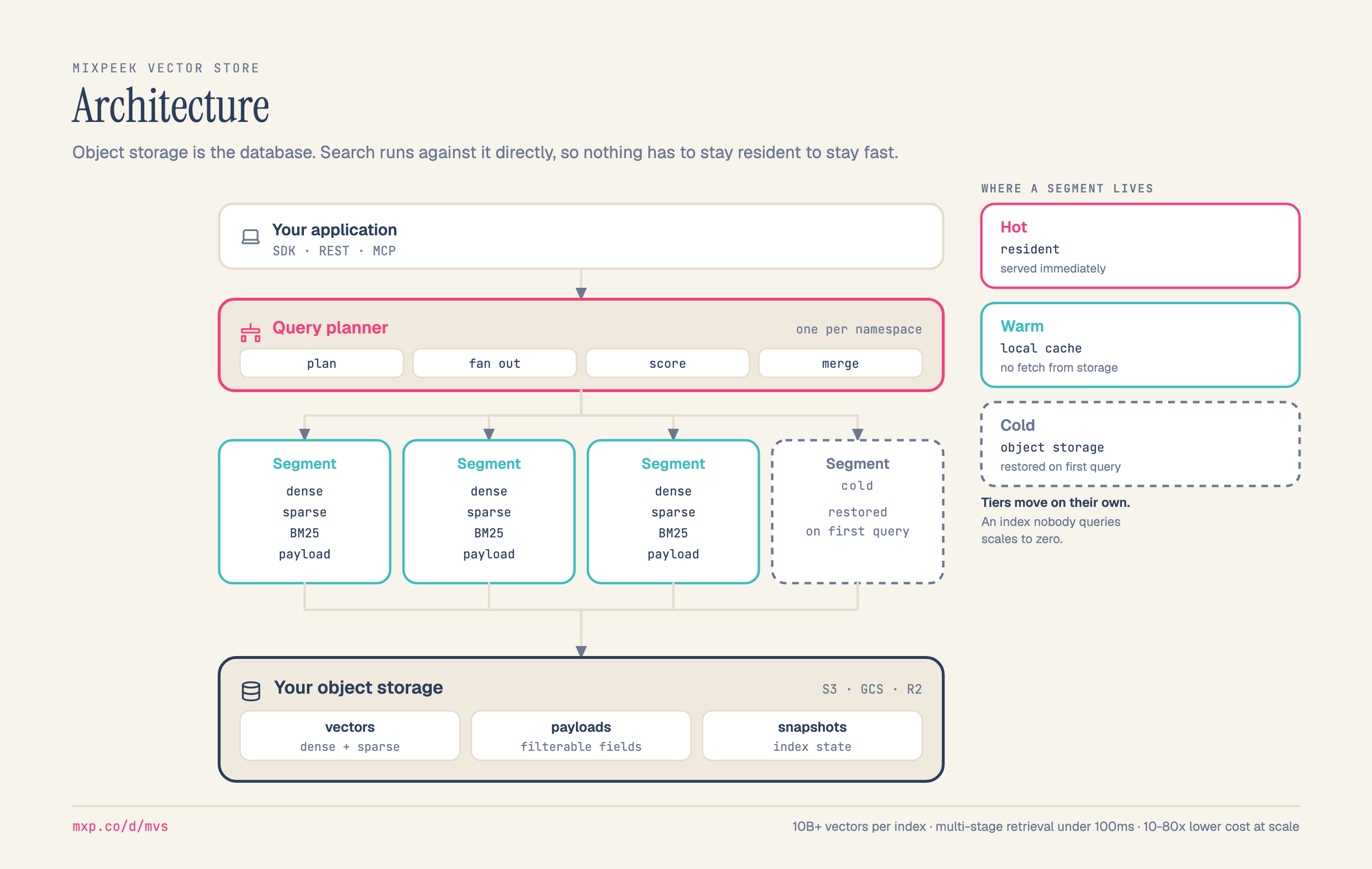
Object storage is the database. A query planner fans out across segments and merges, and the segments themselves are cheap to drop because the bucket already holds everything they need.
Most vector databases ask you to move your embeddings into their storage, then keep a cluster warm so queries stay fast. You pay for that cluster whether anyone searches or not, and the bill tracks the size of the corpus rather than the traffic against it.
MVS treats your bucket as the database. Vectors, payloads and index snapshots all live in object storage you own, and search runs against them there.
A query arrives through the SDK, REST or MCP and hits a query planner, one per namespace. The planner plans, fans out, scores and merges. It fans out to segments, and each segment answers dense, sparse, BM25 and payload filters over its own slice, so one query covers all four without you running three systems and reconciling the rankings yourself.
Segments are cheap to throw away, which is the part that makes the economics work. Everything a segment needs is already in the bucket, so a cold one is restored on first query rather than kept alive against the chance of one. Hot means resident. Warm means a local cache with no fetch. Cold means object storage. Tiers move on their own and an index nobody queries scales to zero.
That is where the published 10 to 80 times cost range at scale comes from: quiet corpora stop costing money.
What this diagram leaves out is how the segments are implemented. If that is the conversation you want, book the architecture review and we will run it on your workload.
Where this diagram appears
Bring your own vectors
Dense, sparse and BM25 search on the object storage you already pay for. From $25/mo.
Explore MVS