NEWVectors or files. Pick a path.Start →
    Video Understanding
    9 min read
    Updated 2026-07-09

    Video Highlight Detection: How AI Finds the Best Moments

    How AI turns hours of footage into highlights: shot and scene decomposition, per-modality moment scoring (visual, audio, transcript), interval merging, and per-video ranking — with the real architectures behind sports highlight generators and meeting recap tools.

    Video Highlights
    Moment Detection
    Video AI
    Temporal Grounding
    Sports Analytics
    Video highlight detection pipeline: a video is decomposed into shots and segments, each segment is scored across visual, audio, and transcript signals, contiguous high-scoring intervals merge into moments, and moments are ranked per video.
    Video highlight detection pipeline: a video is decomposed into shots and segments, each segment is scored across visual, audio, and transcript signals, contiguous high-scoring intervals merge into moments, and moments are ranked per video.


    The Short Answer


    AI finds highlights in video with a four-stage pipeline: decompose the video into segments (shot boundaries, silence gaps, or fixed windows), score each segment using signals from every modality (visual embeddings, audio energy, transcript semantics, on-screen text), merge contiguous high-scoring intervals into coherent moments, and rank the moments per video. No single model "watches" the whole video; the intelligence is in combining per-segment signals into interval-level decisions.

    How does AI decide what counts as a highlight?


    A highlight is a spike in some signal that correlates with what viewers care about, and reliable systems combine several:

  1. Visual change and action density. Shot-boundary detectors (frame-difference histograms, or learned models like TransNet V2) find cuts; dense cutting plus high motion often marks action. Frame embeddings scored against a text query ("goal celebration", "product reveal") turn generic action into relevant action.
  2. Audio energy and events. Crowd noise spikes, applause, whistles, and music stings are the cheapest reliable highlight signals — sports highlight generators lean on them heavily. Audio event classifiers add precision beyond raw loudness.
  3. Transcript semantics. For talks, meetings, and podcasts, the transcript carries the signal: embedding each speech segment and scoring against topics ("pricing discussion", "decision made") finds the moments audio energy misses entirely.
  4. On-screen text. Scoreboard changes, lower-thirds, and slide transitions are machine-readable markers of state change — OCR on keyframes catches them.


  5. Why segments and not whole videos?


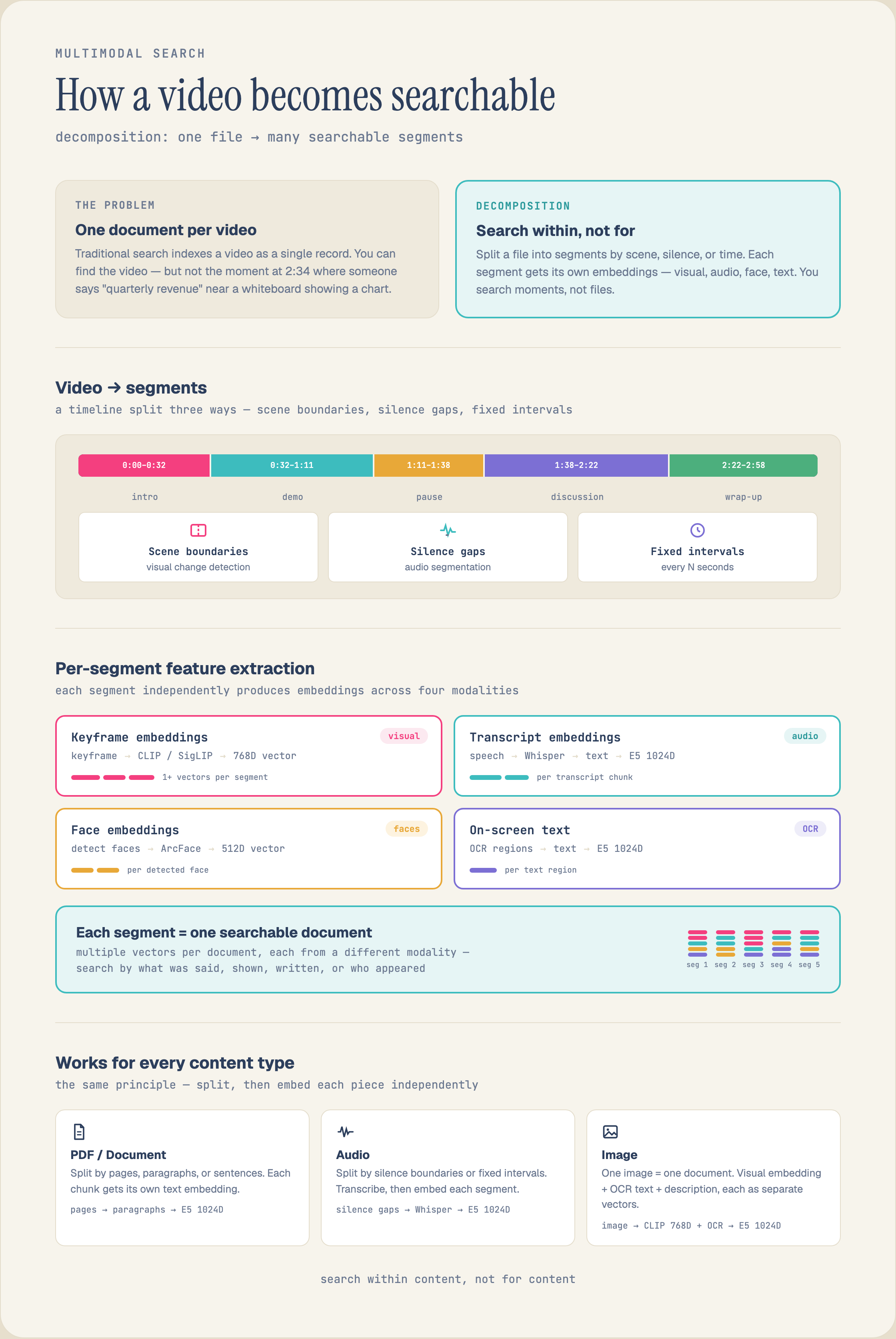
    Because a 60-minute video with one great minute should surface that minute. Per-segment scoring keeps time-resolution: each shot or window gets its own embeddings and scores, so retrieval and ranking operate on moments with start/end timestamps rather than one blurred average for the file. This is the same decomposition that makes video searchable at all — highlights are a ranking layer on top of it.

    How do intervals become moments?


    Raw high-scoring segments are fragmentary: three adjacent 2-second windows above threshold are one 6-second moment, not three results. Moment grouping merges intervals that are contiguous within a gap tolerance (typically 1-3 seconds), aggregates their scores (max or mean), enforces a per-video cap, and drops sub-threshold leftovers. Getting this merge step right is most of the difference between a usable highlight reel and a stutter of near-duplicate clips.

    Highlight detection vs temporal grounding: what is the difference?


    Temporal grounding answers "where in this video does X happen?" for a specific query; highlight detection answers "what are the best parts?" — often with no query at all, using engagement-correlated signals. They share machinery (per-segment scoring, interval merging) and differ in the scoring function: grounding scores against a query embedding (how grounding works), highlights score against learned or heuristic interestingness. Scene segmentation is the shared substrate for both (how scene detection works).

    How real systems compose it


  6. Sports: audio spikes + scoreboard OCR + action recognition, merged with tight tolerances; the reel is the top-N moments by aggregated score. See the sports highlight pipeline.
  7. Meetings and talks: transcript-first — segment on speaker turns, score against agenda topics and decision language, merge by topic continuity.
  8. UGC and marketing: query-driven — score every segment against campaign concepts with multimodal embeddings, so "highlights" match what the brand is looking for this week.


  9. Doing this on Mixpeek


    Mixpeek runs the whole pipeline as infrastructure: video ingestion decomposes files into per-segment documents with visual, transcript, face, and on-screen-text features; a retriever scores segments against any query; and the moment_group stage merges scored intervals into ranked moments per video — with merge_tolerance_ms, a score aggregation strategy, and a per-video cap as stage parameters. The result is timestamped moments ready for a player or an editing tool, over content that stays in your own object storage. Video processing is metered per minute on the rate card; the models behind the signals are on the models page. For tool selection, start with the best AI video analysis tools.
    Managed Mixpeek

    Put multimodal search to work

    Connect a bucket and Mixpeek runs the whole multimodal search pipeline for you: extraction, indexing, and search over your own objects. No models to wire up, nothing to host.

    Start with Managed
    MVS · bring your own

    Already have vectors?

    Keep your embeddings on your own cloud and run dense, sparse, and BM25 search directly on object storage. From $25/mo.

    Start with MVS

    Run this on your own data

    Point Mixpeek at the storage you already have and search your video, images, audio, and documents the way this guide describes. First 1M vectors included.

    Search your own archive, freeRead Docs