Reduce
Temporal
Group documents by time windows and compute per-window aggregations with drift detection
On one real run
A Nine-Second Day Disappears Into a Two-Second Average: What Temporal Windows Show That a Mean Hides
Mixpeek writes every retriever execution into mxp_retriever_executions in your own namespace, so a retriever can read your own telemetry. Grouped by day, one window on 2026-09-04 averaged 9,397 ms against neighbours near 2,500, on only 10 executions. Averaged across the full period that day contributes almost nothing and disappears; bucketed by day it is the tallest bar on the chart.
See the full diagram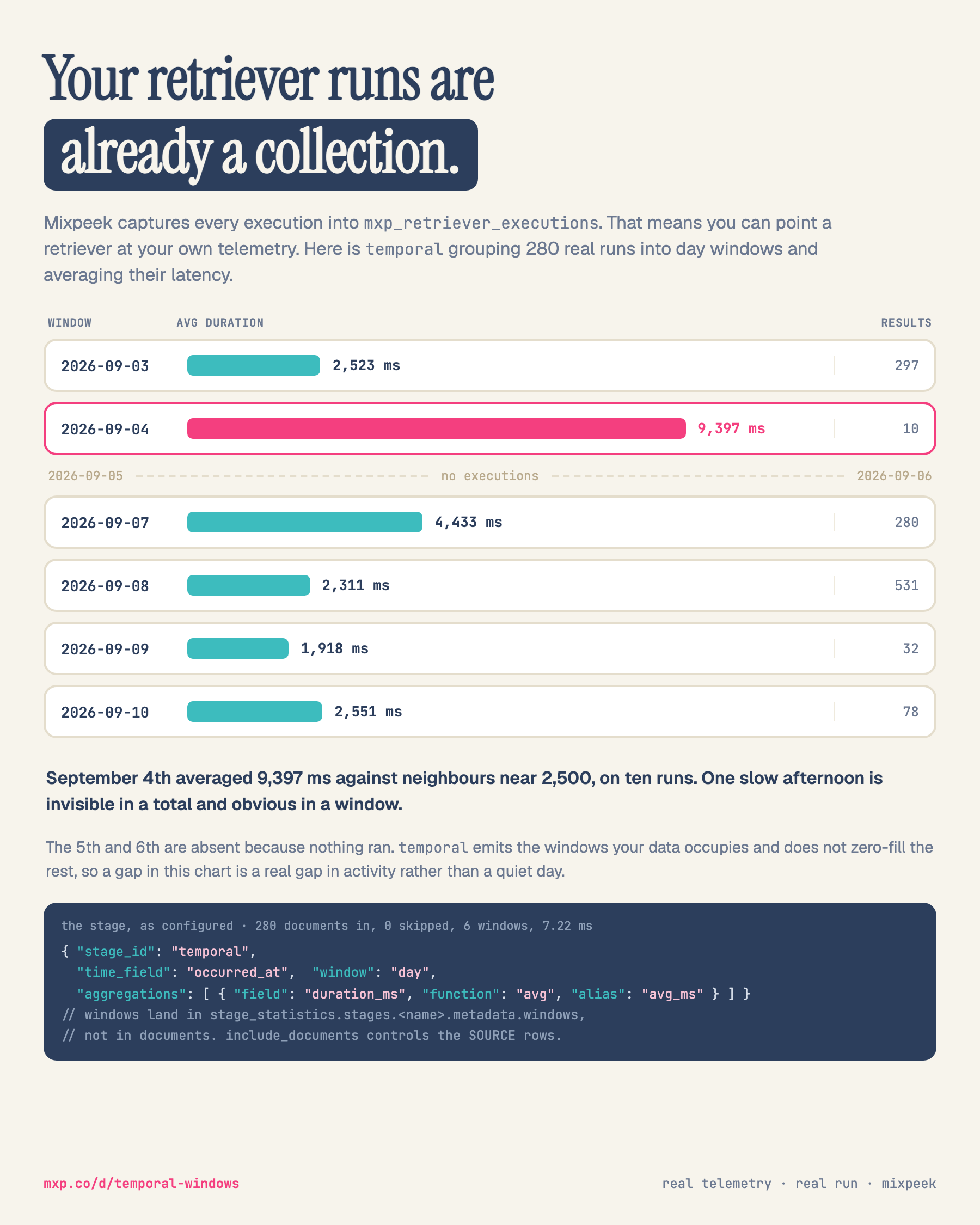
Note: This playground provides simulated output to showcase functionality. No data is processed on our servers. Use this demo to explore the stage's configuration options before integrating it into your retriever pipeline.
Configuration
string
Required
REQUIRED. Field containing timestamps.
string
Time window size (e.g., '1h', '1d', '7d').
array
Aggregations to compute per window.
Output
No output yet
Configure the stage parameters and click "Run Stage" to see the simulated output.