Multimodal Search as an MCP Tool
Multimodal Search as an MCP Tool
MCP is becoming the default bridge between agents and external tools. Most of those tools speak text. Ours speaks video, images, audio, and documents.
Mixpeek now exposes its retrieval stack over MCP. Claude, Cursor, or any agent can search a multimodal warehouse directly: no custom integration layer per app.
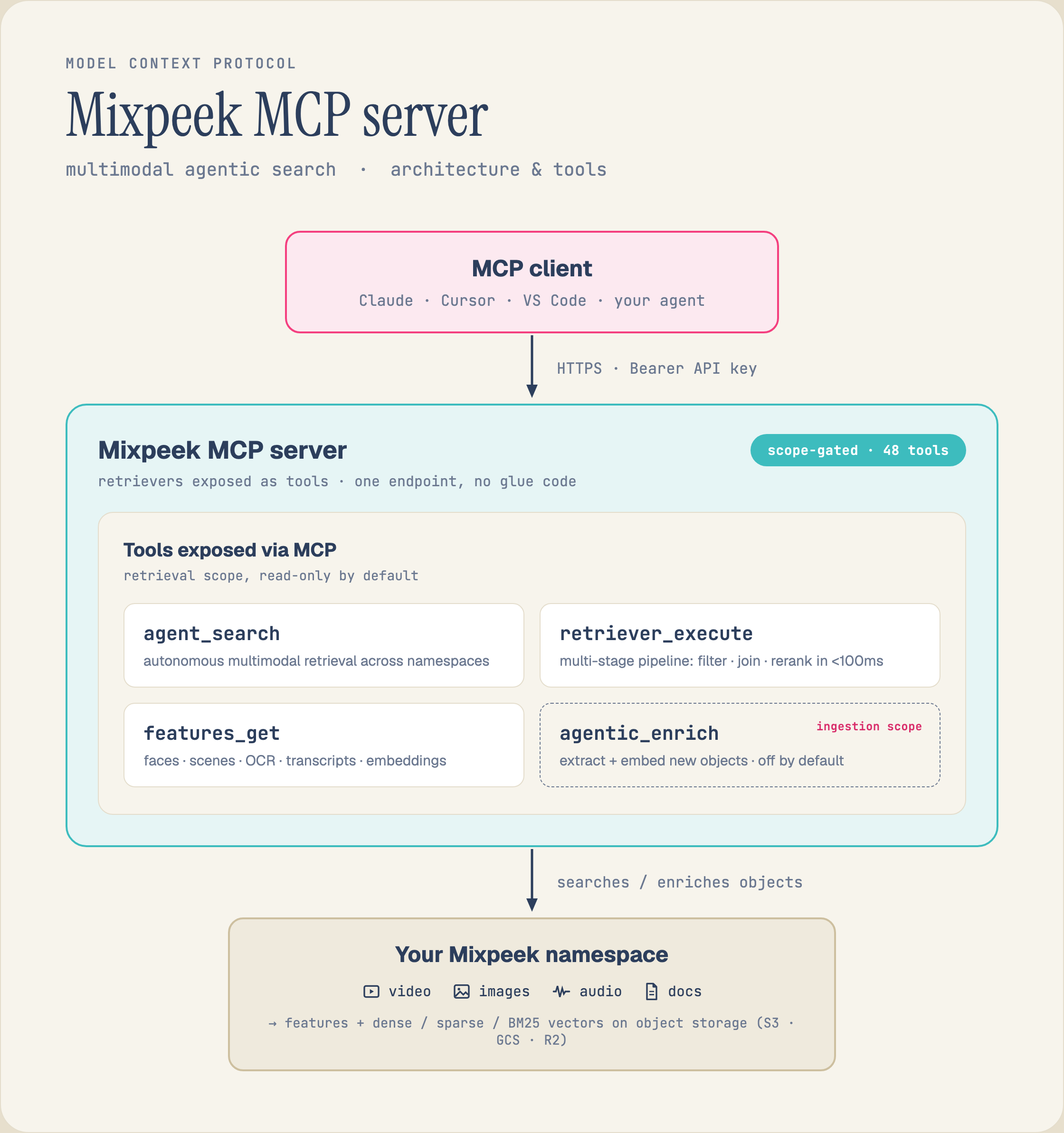
What gets exposed isn't a raw vector-similarity call. It's your retrievers: configurable multi-stage pipelines that filter, join, and rerank in under 100ms, surfaced as tools.
A few of the tools an agent gets:
→ agent_search, autonomous multimodal retrieval across namespaces
→ retriever_execute, run a multi-stage pipeline (filter · join · rerank)
→ features_get (read faces, scenes, OCR, transcripts, embeddings
→ agentic_enrich) extract and embed new objects (write scope)
The control point, scopes. Every API key carries a scope: retrieval, ingestion, admin, or full. Connect an agent with a retrieval-scoped key and it can only search. Read-only multimodal retrieval, nothing written.
The default posture is an agent that sees everything and changes nothing.
mixpeek.com/connectors/mcp-server
Run this on your own data
Mixpeek turns video, images, audio, and documents in your object storage into searchable, timestamped results through one API.
Search your own data