MUVERA: Why Query and Document Are Encoded Asymmetrically
Why Query and Document Are Encoded Asymmetrically
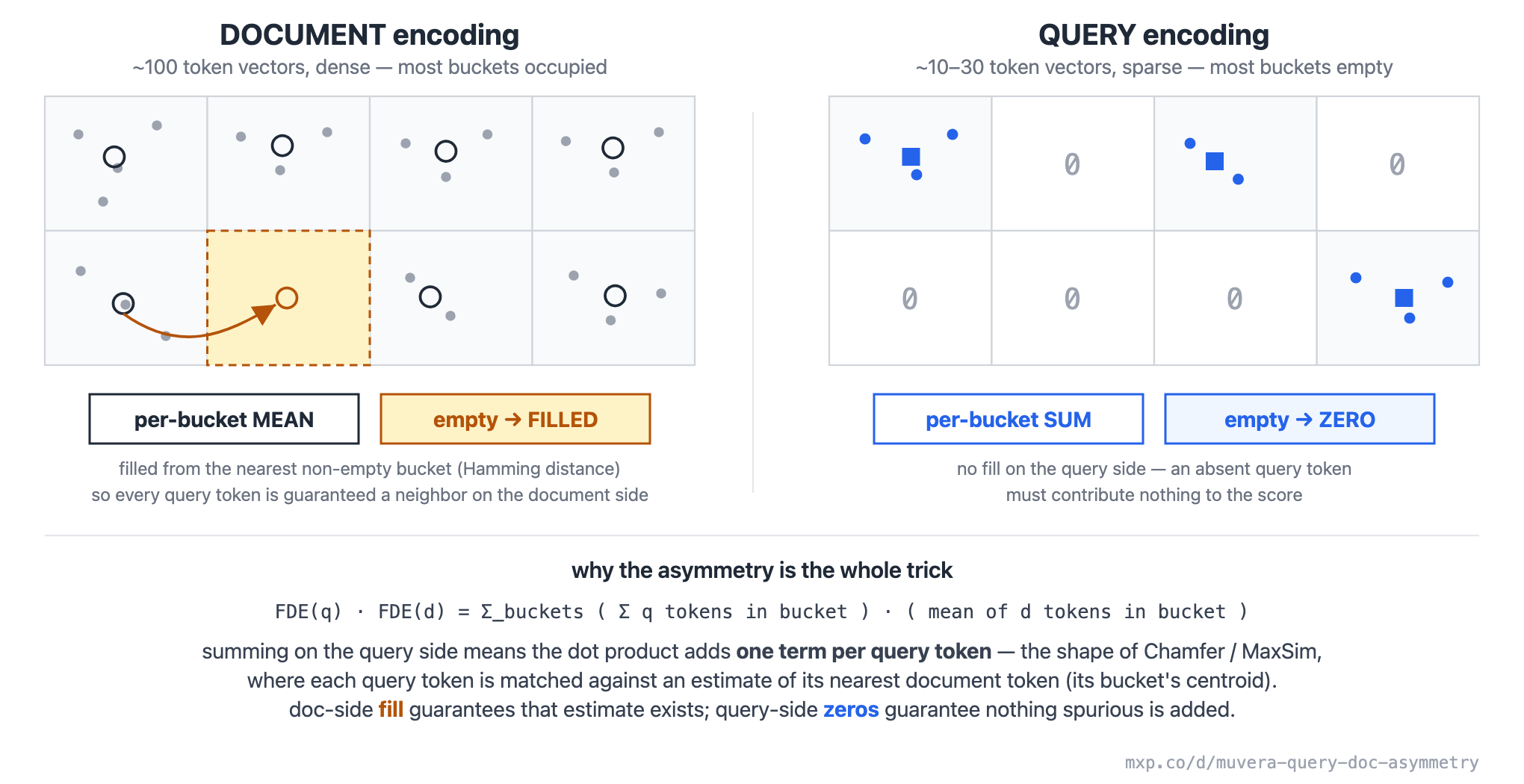
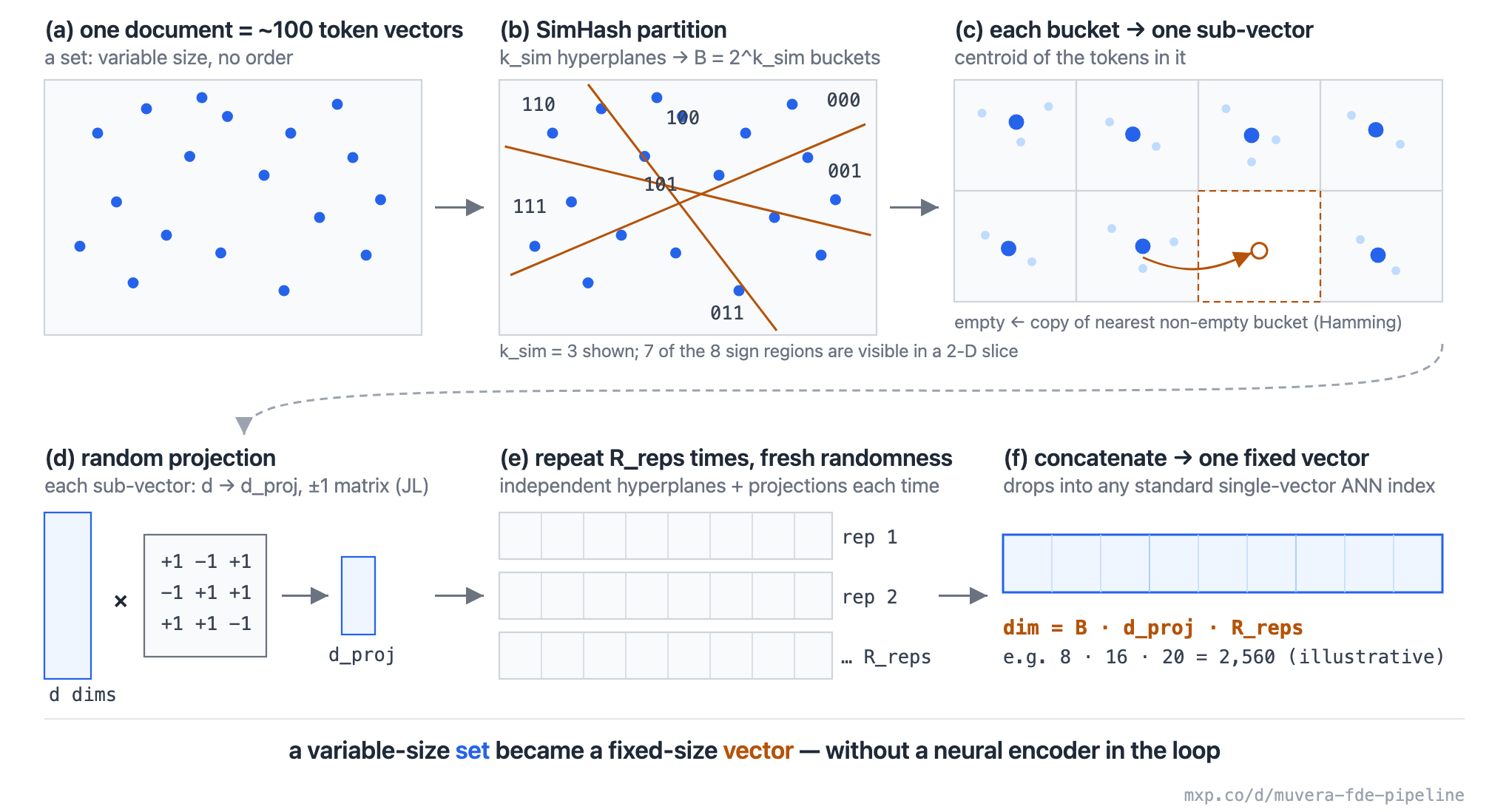
The trick that makes MUVERA's fixed vectors approximate Chamfer similarity is that queries and documents are encoded differently. A document has ~100 token vectors, so most buckets are occupied: each bucket takes the mean of its tokens, and any empty bucket is filled from the nearest non-empty bucket (by Hamming distance), so every possible query token is guaranteed a document-side neighbor to match against. A query has only ~10-30 token vectors, so most buckets are empty: each bucket takes the sum of its tokens, and empty buckets stay zero, an absent query token must contribute nothing. Written out, FDE(q) · FDE(d) = sum over buckets of (sum of query tokens) x (mean of document tokens): summing on the query side adds one term per query token, which is the shape of Chamfer / MaxSim, where each query token is scored against an estimate of its nearest document token. Doc-side fill guarantees that estimate exists; query-side zeros guarantee nothing spurious is added.
Where this diagram appears
Run this on your own data
Mixpeek turns video, images, audio, and documents in your object storage into searchable, timestamped results through one API.
Search your own data