AI Video Captioning Models for Search: Captions, Embeddings and Hybrid Retrieval
How to make video searchable with AI captions: caption and transcribe each segment, then fuse keyword and vector search and filter by metadata.
Research
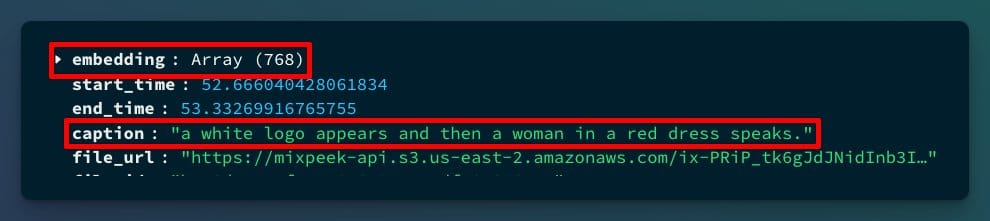
How do you use AI video captions to search video? Split each video into short segments, write a caption for each segment with a vision-language model, and transcribe its speech with a model such as Whisper. Index the caption and transcript text for keyword search (BM25) and store an embedding of each segment for vector search. At query time, run both searches, merge the two ranked lists with reciprocal rank fusion, and narrow the results with metadata filters such as date or channel. Keyword search finds exact names and phrases. Vector search finds scenes whose captions use other words.
Signal
What it captures
What it misses
Example model
OCR
Text on screen: titles, signs, prices, logos with words
Updated October 2026: the original post below pairs TF-IDF on captions with k-nearest-neighbor search on embeddings. Most systems built today use BM25 for the text side and an approximate nearest neighbor index such as HNSW for the vectors, merged with reciprocal rank fusion. The design is the same. See our guide to BM25 and vector fusion for the merge step.
Why are OCR and transcription not enough for video search?
Traditional methods like Optical Character Recognition (OCR) and transcription have long served as the backbone of video captioning.
OCR is excellent for extracting text from images and videos, while transcription translates spoken language into written text. However, these methods are limited in scope—they focus solely on either the visual text (OCR) or the audio content (transcription) without considering the full context of a video, such as the relationship between images, sounds, and the underlying scene.
By combining audio, visual, and contextual data into a single, comprehensive caption, this method provides a more holistic understanding of video content.
When integrated with video embeddings and metadata filters, it becomes a powerful tool for hybrid retrieval systems, offering improved precision in Retrieval-Augmented Generation (RAG) workflows.
What does an AI video caption capture?
Unlike OCR, which extracts only the text visible on-screen, or transcription, which captures only the spoken words, advanced video captioning synthesizes information from multiple modalities. It analyzes visual elements, audio cues, and scene context to produce captions that reflect a more nuanced understanding of what is happening in each frame.
For example, in a video where someone is speaking at a podium with applause in the background, traditional transcription might only capture the spoken words, and OCR might miss the context entirely. Advanced video captioning, however, would generate a caption that not only includes the spoken words but also acknowledges the applause and the visual scene of a person at a podium, thereby creating a richer, more meaningful description.
How do captions, embeddings and filters work together in hybrid retrieval?
Advanced video captioning is particularly powerful when combined with video embeddings and metadata filters in hybrid retrieval systems. Embeddings capture the underlying structure and context of the video content, mapping similar scenes or concepts into a shared vector space. When paired with captions, which provide human-readable descriptions, the system can achieve more accurate and context-aware retrieval.
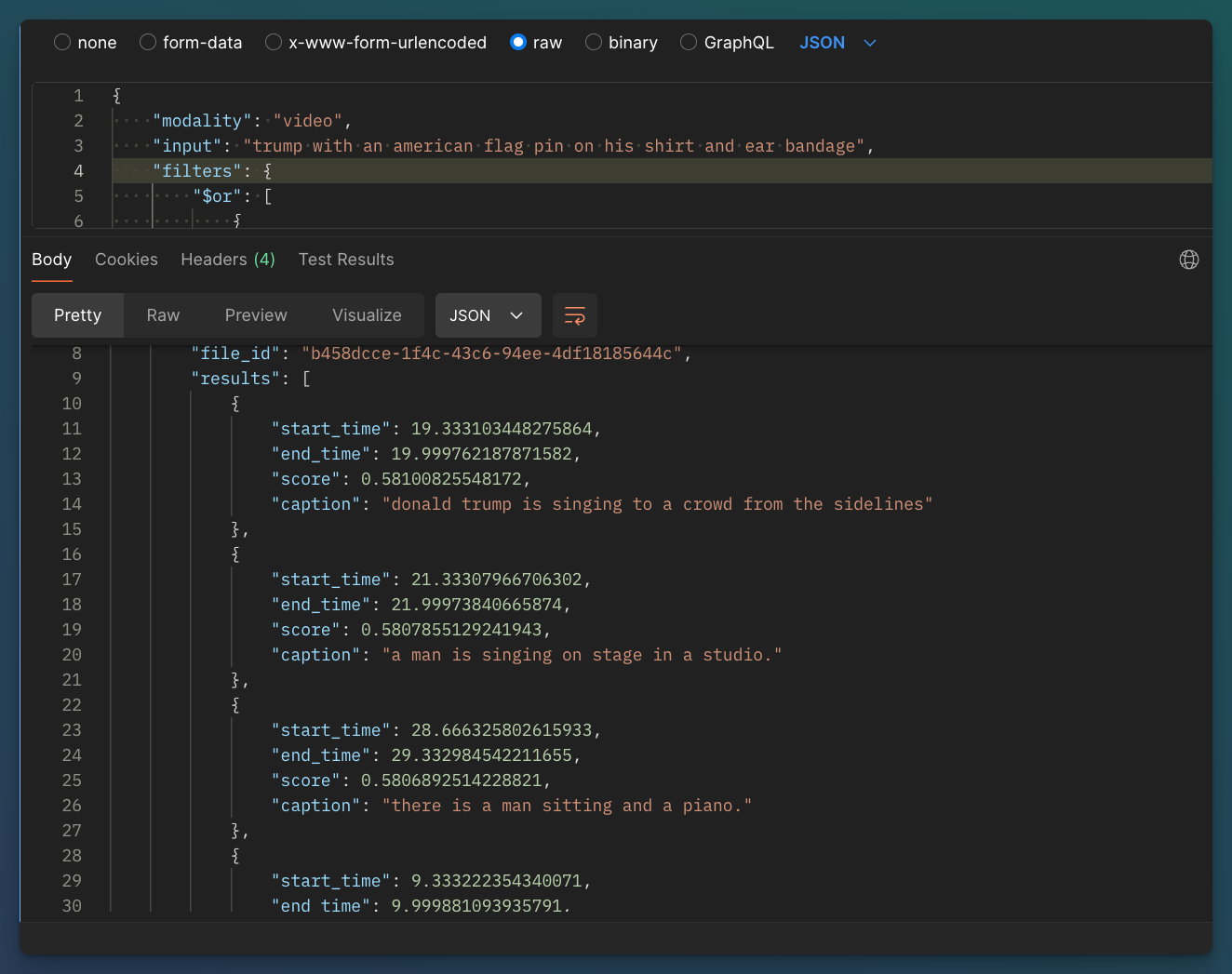
In RAG workflows, this hybrid approach is invaluable. Metadata filters can further refine the retrieval process by narrowing down search results based on specific attributes like location, time, or speaker identity. The combination of TF-IDF (Term Frequency-Inverse Document Frequency) for captions and KNN (k-Nearest Neighbors) for embeddings enables a robust search mechanism. TF-IDF excels at identifying important terms within the captions, while KNN leverages the embeddings to find conceptually similar content.
Where is caption-based video search used?
Legal and Compliance Reviews In legal proceedings, videos often serve as critical evidence. Using advanced captions, legal teams can quickly identify and retrieve relevant clips that contain specific spoken phrases or visual elements, like a person signing a document. Combining captions with embeddings ensures that the search results not only match the keywords but also the context, such as identifying all scenes where the person is interacting with the document, regardless of the exact wording used.
Educational Content Analysis In educational settings, video content is frequently used to illustrate complex concepts. Teachers and researchers can use advanced video captioning to search for specific moments in a lecture where a particular concept is explained, such as a math problem being solved on a chalkboard. Embeddings help find similar explanations across different videos, while captions ensure that the search results are human-readable and relevant, facilitating more efficient content review and reuse.
Media Monitoring and Content Moderation In media monitoring, it’s essential to track how certain topics are discussed across various platforms. By combining captions with embeddings, media analysts can quickly find all instances where a specific topic, like a political issue, is mentioned, even if the language used varies. Captions provide clear, human-readable validation, while embeddings capture the broader context, helping to identify related content that might not use the exact keywords.
Can you fine-tune captions and embeddings for your own footage?
One of the most significant advantages of this advanced system is its flexibility. Both captions and embeddings can be fine-tuned for specific out-of-distribution use cases. Fine-tuning involves adjusting the model to better recognize and interpret content that it wasn’t initially trained on, making it possible to achieve high precision in specialized domains.
For example, a security firm might need to fine-tune the system to recognize specific actions, such as identifying when someone is retrieving an object from a pocket. While a general model might not excel at this task, fine-tuning the captions and embeddings allows the system to become highly accurate in identifying and contextualizing such actions.
Where video captioning and hybrid retrieval are heading
Advanced video captioning represents a significant leap forward from traditional methods like OCR and transcription. By integrating these captions with embeddings and metadata filters, we can create hybrid retrieval systems that offer unparalleled precision and context-awareness, especially in complex RAG workflows. Whether for legal reviews, educational analysis, or media monitoring, the combination of TF-IDF and KNN in video retrieval provides robust, human-readable results that can be fine-tuned to meet the unique demands of any industry.
As video content continues to grow in volume and importance, the ability to effectively search, understand, and utilize that content will be increasingly vital. With advanced video captioning and hybrid retrieval, we are better equipped than ever to meet this challenge.
Frequently asked questions
What is the difference between video captioning, OCR and transcription?
OCR reads text that appears in the frame. Transcription turns speech into text. A caption is a vision-language model's written description of what happens in a segment: who is there, what they do and where. A search index for video usually stores all three per segment, because each one finds clips the other two miss.
Which models generate video captions for search?
Vision-language models such as Gemini and the Qwen-VL family write the captions, and Whisper is the common choice for speech. Mixpeek's multimodal extractor runs Whisper transcription, Gemini descriptions and OCR on each segment when you set run_transcription, run_video_description and run_ocr, and stores each result as a field you can search and filter.
How long should each captioned video segment be?
Short enough that a result points at the moment someone wants. Mixpeek's default splits video every 10 seconds (split_method: "time", time_split_interval: 10), and scene or silence splitting cuts at shot changes or pauses, with any segment over 30 seconds subdivided. Very short segments produce near-identical captions, so 5 to 15 seconds is a sensible range to test.
How do you merge caption search and vector search results?
Reciprocal rank fusion is the usual method. Each result scores the sum of 1 / (k + rank) over the lists it appears in, with k = 60 in the original paper by Cormack, Clarke and Büttcher (2009). It needs only ranks, so the BM25 scores and the vector distances never have to share a scale.
When should I search captions and when embeddings?
Search captions and transcripts when the query names something exact: a person, a product, a quote, a number. Search embeddings when the query describes a scene, such as "someone opening a car door at night". Run both when you cannot predict the query, which is most of the time, and fuse the results.
What do metadata filters add to hybrid video retrieval?
Filters drop segments that cannot be right before ranking runs: the wrong date range, channel, language or speaker. That raises precision without changing either model, and it keeps a RAG prompt from quoting a clip from the wrong source.