The Retrieval Feedback Flywheel
The Retrieval Feedback Flywheel
The best search systems aren't the ones with the best model on day one. They're the ones that learn fastest from being used.
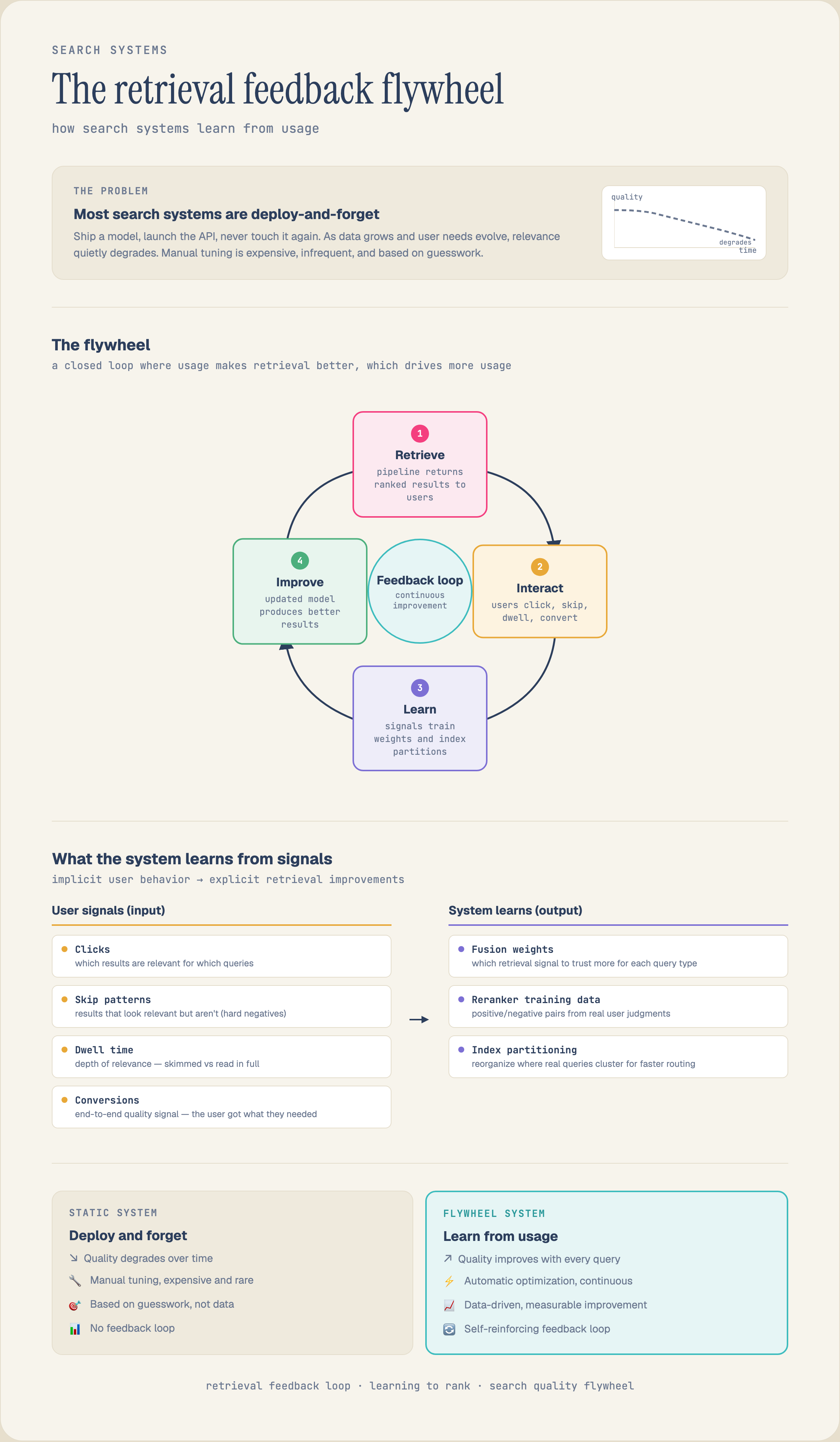
Most systems are deploy and forget. You ship a model, launch the API, check the box. Then the data grows, user needs shift, and relevance quietly rots. The only fix on offer is expensive manual tuning built on guesswork.
A flywheel is the other option: a closed loop where usage makes retrieval better, and better retrieval drives more usage.
It runs in four steps. You retrieve ranked results. Users interact by clicking, skipping, dwelling, converting. Those signals train the system. The updated model returns better results, and around it goes again.
And the signals are rich. Clicks tell you which results are relevant for which queries. Skips tell you which results look relevant but aren't, your hard negatives. Dwell time tells you how relevant, skimmed versus actually read. Conversions give you the end-to-end signal.
Those feed three concrete things: fusion weights, so you know which retrieval signal to trust more; reranker training pairs pulled from real judgments; and index partitioning that reorganizes around where real queries actually cluster.
A static system decays. A flywheel compounds. The gap gets wider with every query.
Where this diagram appears
Run this on your own data
Mixpeek turns video, images, audio, and documents in your object storage into searchable, timestamped results through one API.
Search your own data