What is Representation Learning
Representation Learning - Learning useful features from raw data automatically
Representation learning, sometimes written representational learning, is the branch of machine learning in which a model discovers useful features from raw data on its own, so nobody has to hand-engineer them. Its output is usually a vector or a small set of features that makes later work such as search, classification and clustering easier.
How It Works
A model reads raw input such as pixels, audio samples or text and trains to produce a compact representation that keeps what a task needs. Training can be supervised, where labels for one task produce features you reuse for another, or self-supervised, where the data supplies its own training signal, as in contrastive learning. Bengio, Courville and Vincent's review defines the goal as learning representations that make it easier to extract useful information when building classifiers or other predictors.
Representation Learning vs. Embeddings
An embedding is one common output of representation learning: a dense vector for one item. Representation learning is the wider field and the training behind it, and it can also produce sparse vectors, one vector per patch or token, or a handful of named features. See how Mixpeek generates embeddings for the applied version.
Technical Details
Common methods include contrastive learning (CLIP, SimCLR), autoencoders, masked prediction (MAE, V-JEPA) and reusing a trained classifier's penultimate layer. Matryoshka Representation Learning trains a vector so its first dimensions are usable alone, which lets you truncate it to save storage. No single metric measures representation quality (survey), so teams test on the downstream task, such as retrieval recall or the accuracy of a linear classifier trained on the features.
Representation Learning in Mixpeek
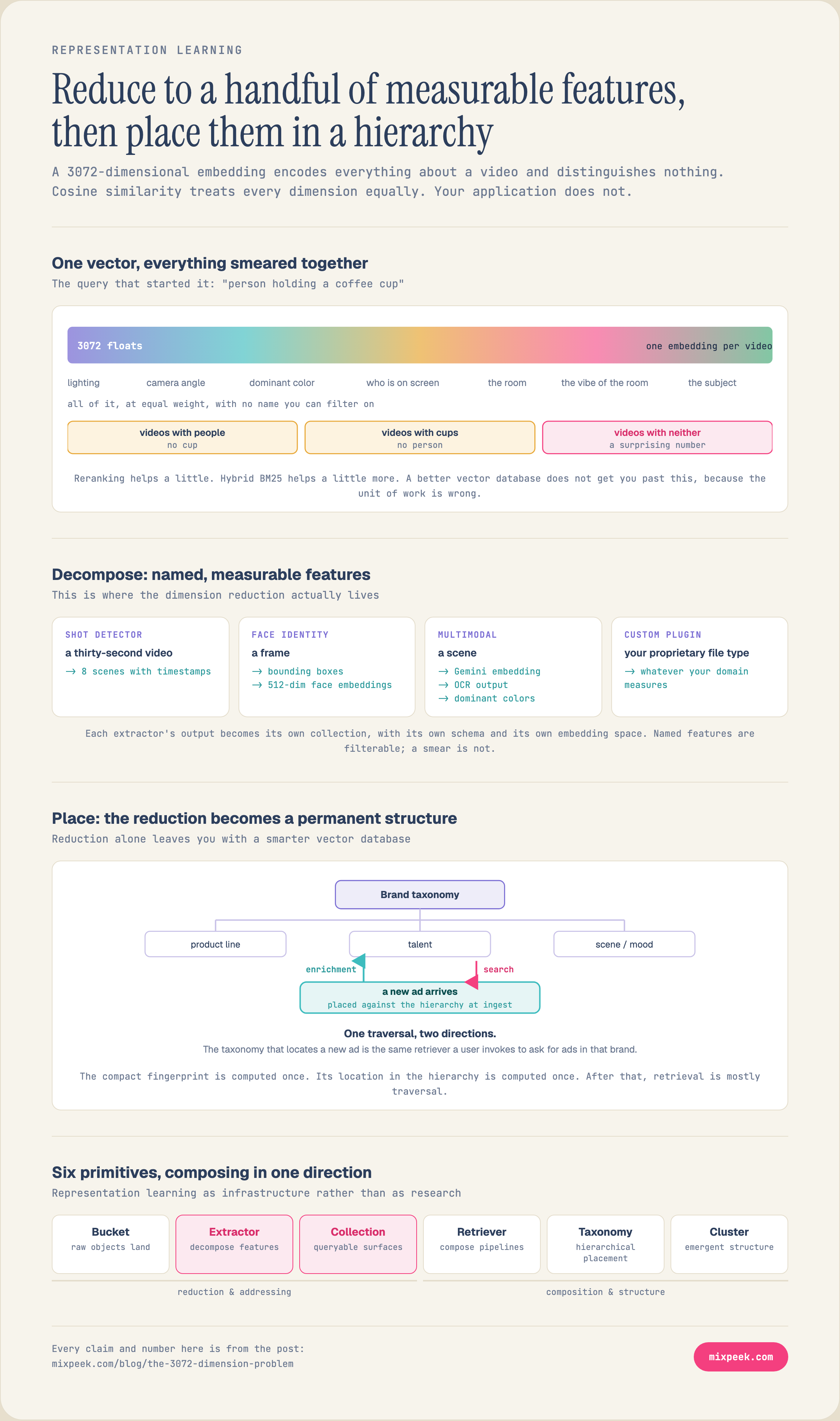
Mixpeek runs learned models over your files at ingest and keeps what they produce as named features. One embedding of a whole video spreads lighting, camera angle, people and setting across the same dimensions, a problem covered in The 3072-Dimension Problem. Extractors split that into separate outputs: a shot detector returns scenes with timestamps, and a face model returns bounding boxes and 512-dimension face embeddings. Each output becomes its own collection that retrievers can search and filter, taxonomies can place in a hierarchy, and clusters can group.
Best Practices
- Choose the representation by the query you need to answer, since a model trained for image similarity may miss what your search needs
- Evaluate on your own data and task, because public benchmark scores often fail to transfer
- Keep separate representations for separate questions (faces, on-screen text, scenes) so each can be filtered and weighted
- Store the source files and the model version so you can re-index when a better model arrives
Common Pitfalls
- Expecting one vector to carry every attribute of a long video or document
- Comparing vectors from different models or versions, which live in different spaces
- Treating a good training loss as proof of good retrieval
- Truncating a vector from a model that was not trained for it, which discards meaning at random
Advanced Tips
- Fine-tune a pretrained encoder on your domain before training one from scratch
- Use small vectors for a fast first pass and full-size vectors to rerank the shortlist
- Use multi-vector models such as ColPali when exact regions of a document or frame matter
- Use taxonomies to turn learned features into a hierarchy people can browse and filter
Put multimodal search to work
Connect a bucket and Mixpeek runs the whole multimodal search pipeline for you: extraction, indexing, and search over your own objects. No models to wire up, nothing to host.
Start with ManagedAlready have vectors?
Keep your embeddings on your own cloud and run dense, sparse, and BM25 search directly on object storage. From $25/mo.
Start with MVS