How Meta Cut Its Ads Model Serving Cost From 24.6x to 3.9x (HILL, Explained)
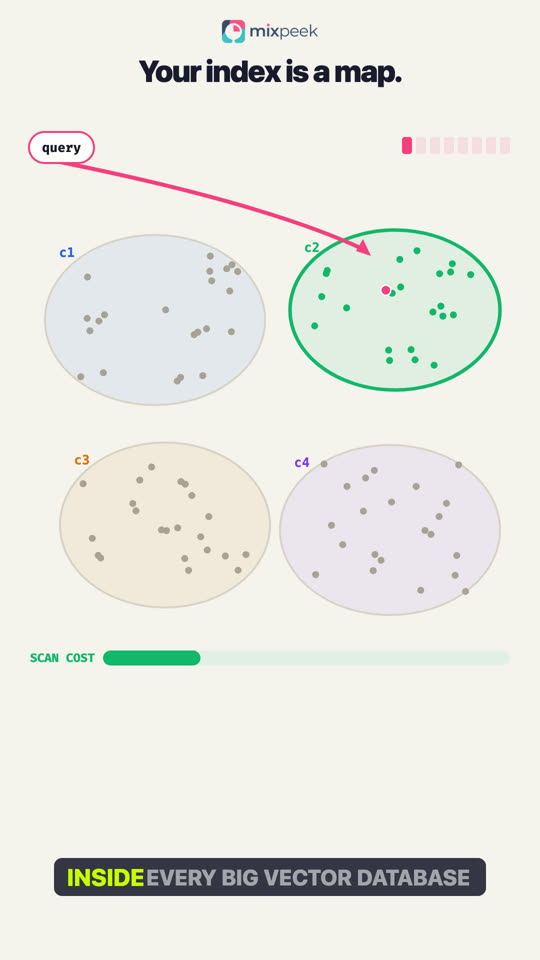
Meta's teardown of MoNN (the retrieval model behind Facebook/Instagram ads) plus HILL, the hierarchical index that made it affordable: organizing every item into a learned tree keeps +6.0% recall at 3.9x cost instead of 24.6x.
Where this fits in Mixpeek
Serving a heavy retrieval model over a huge catalog is a cost problem, not just a quality one. Hierarchical, learned indexes like HILL are the pattern for keeping most of a big model's recall at a fraction of the serving cost: directly relevant to how Mixpeek scales retrievers over large multimodal corpora, where the two-tier retrieve-then-rerank design trades exhaustive scoring for a cheap structured shortlist.
About this research
Meta published the first systematic teardown of MoNN, the retrieval model behind Facebook and Instagram ads, plus HILL, the hierarchical index that made it affordable. The big model wins +9.4% recall at 24.6x serving cost; organizing every ad into a learned tree keeps +6.0% at 3.9x, and the production A/B moved online metrics +2.57%. Bonus finding: the tree's middle layers double as training sets for test-time fine-tuning. Paper: arxiv.org/abs/2604.12965
Frequently asked questions
Put the research to work
Mixpeek turns video, images, audio, and documents in your object storage into searchable, timestamped results through one API: the retrieval stack these papers describe.
Search your own data