Google's MUVERA: The One-Vector Trick Behind Fast Multi-Vector Search
MUVERA collapses a multi-vector (ColBERT-style) representation into a single Fixed Dimensional Encoding whose dot product provably approximates the multi-vector score: so late-interaction quality can ride an ordinary single-vector ANN index.
Where this fits in Mixpeek
Mixpeek's multi-vector search (MVS) keeps one embedding per token or region for late-interaction quality, which is expensive to serve at scale. MUVERA is the technique that lets that quality run on a standard ANN index: encode each document's token set into one FDE for a cheap first-tier recall pass, then rerank the top candidates with exact Chamfer/MaxSim over the original vectors. It's the theory behind Mixpeek's two-tier retrieve-then-rerank path: cheap recall over everything, exact scoring over the shortlist.
About this research
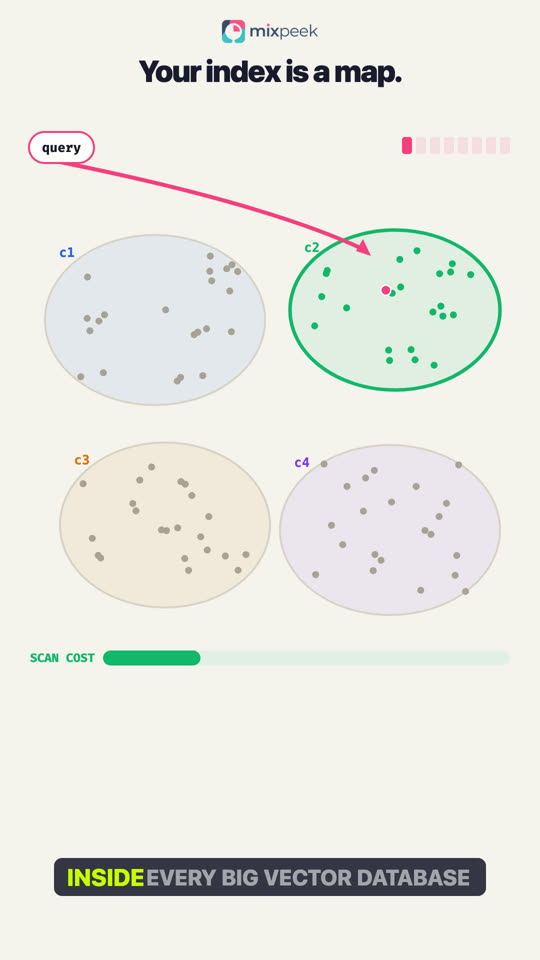
Multi-vector models like ColBERT keep one embedding per token, which wins on accuracy but breaks fast indexes: Chamfer scoring forces custom pipelines like PLAID. MUVERA's Fixed Dimensional Encodings randomly partition the embedding space, aggregate each region's tokens (queries sum, documents average), and concatenate the blocks into one vector whose dot product provably approximates the multi-vector score, the first single-vector proxy with theoretical guarantees. On BEIR: about 10% higher recall at 90% lower latency than PLAID, 2 to 5x fewer candidates, 32x memory compression via product quantization. Paper: arxiv.org/abs/2405.19504
Frequently asked questions
Go deeper
Put the research to work
Mixpeek turns video, images, audio, and documents in your object storage into searchable, timestamped results through one API: the retrieval stack these papers describe.
Search your own data