MUVERA: Why Anisotropic Embeddings Break FDEs (and Mean-Centering Fixes It)
Why Anisotropic Embeddings Break FDEs (and Mean-Centering Fixes It)
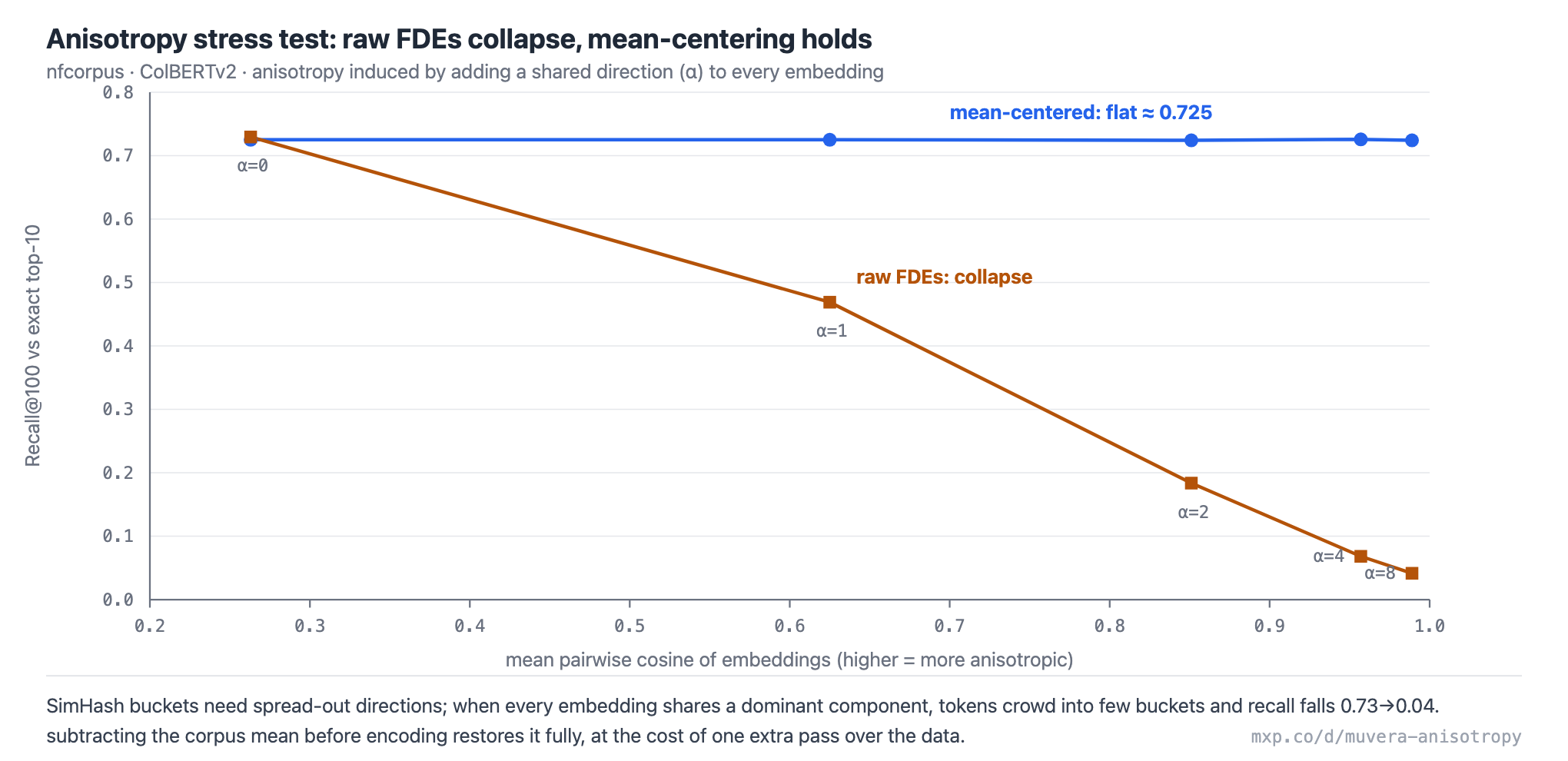
MUVERA's fixed encoding leans entirely on SimHash, which only works when the token vectors point in spread-out directions: a random hyperplane can only separate tokens that actually disagree in direction. This stress test (nfcorpus, ColBERTv2) induces anisotropy on purpose by adding a shared direction (scaled by alpha) to every embedding, driving the mean pairwise cosine from 0.26 up toward 1.0. As the vectors crowd onto one dominant component, raw FDE Recall@100 collapses from 0.73 at alpha=0 to 0.04 at alpha=8: tokens all fall into a handful of SimHash buckets, and the fixed encoding can no longer tell documents apart. Subtracting the corpus mean from every embedding before encoding restores it fully: the mean-centered line stays flat at about 0.725 across the entire sweep: at the cost of one extra pass over the data to estimate that mean. The lesson for deploying MUVERA on real, often anisotropic production embeddings: center first, or the FDE silently degrades.
Where this diagram appears
Run this on your own data
Mixpeek turns video, images, audio, and documents in your object storage into searchable, timestamped results through one API.
Search your own data