Query Expansion: Rewriting the Question Before You Search
Query Expansion: Rewriting the Question Before You Search
Your users type two words into a search box. Those two words are a lossy compression of everything they actually meant.
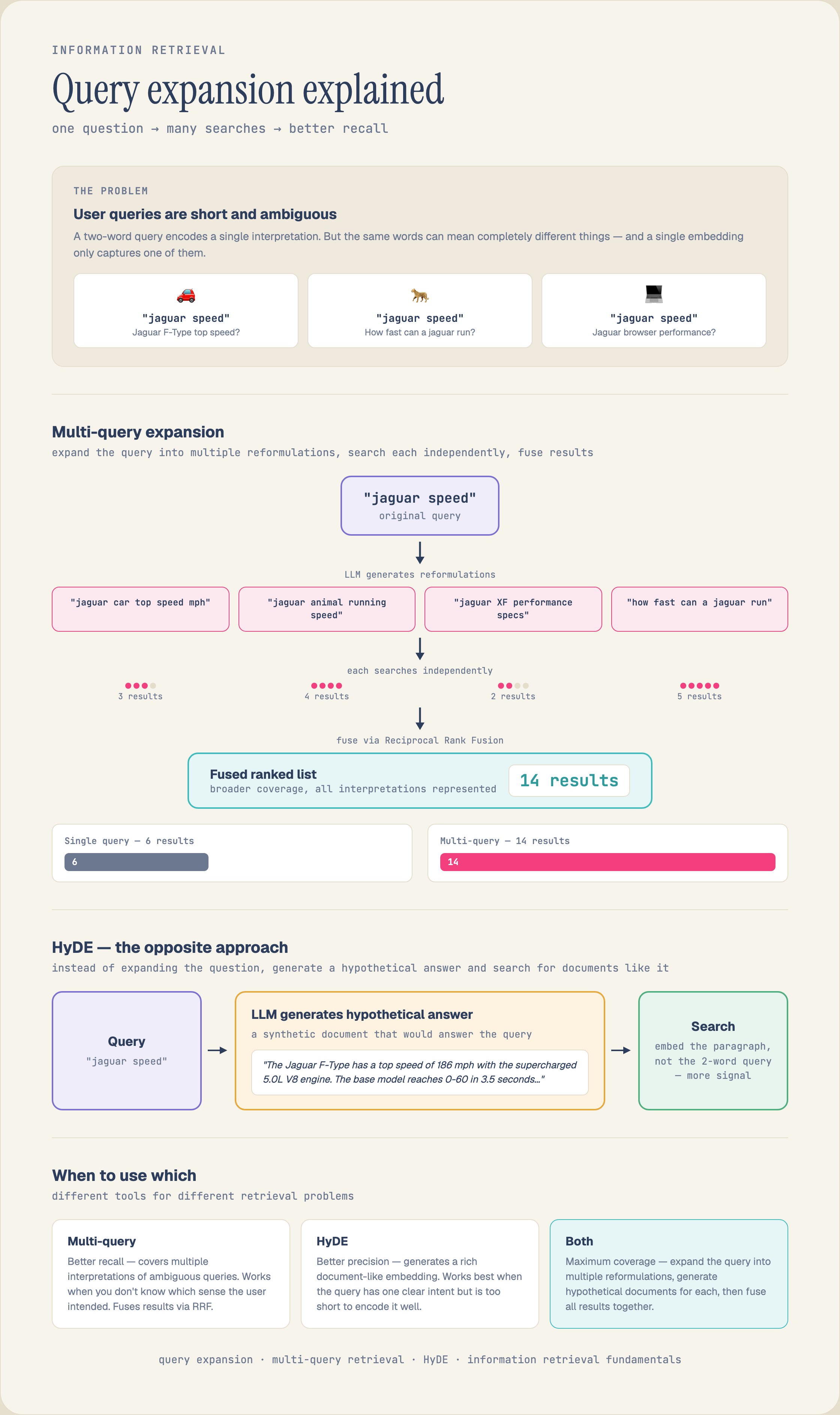
Take "jaguar speed." Car, animal, or browser? A single embedding locks onto one reading. Whichever one the model picks, the other two just vanish.
Query expansion comes at this from two angles.
Multi-query has an LLM rewrite the question into several versions: "jaguar car top speed mph," "jaguar animal running speed," "how fast can a jaguar run." Each one searches on its own, then the results fuse with Reciprocal Rank Fusion. One query finds 6 results. Four rewrites find 14, and they cover every reading of the question.
HyDE flips it around. Instead of expanding the question, you generate a hypothetical answer, a short made-up paragraph that would answer it, and search for documents close to that paragraph rather than the two-word query. A full paragraph carries far more signal than two words ever could.
When to use which: multi-query when the query is genuinely ambiguous, HyDE when the intent is clear but the query is too short to say it, both together when you want maximum coverage.
The real point is that retrieval quality isn't only about better embeddings. It's about handing the system enough signal to work with. Short queries starve it.
Run this on your own data
Mixpeek turns video, images, audio, and documents in your object storage into searchable, timestamped results through one API.
Search your own data