Wide net first, careful read second
Reranking re-scores first-stage candidates with a cross-encoder so the best results rise to the top.
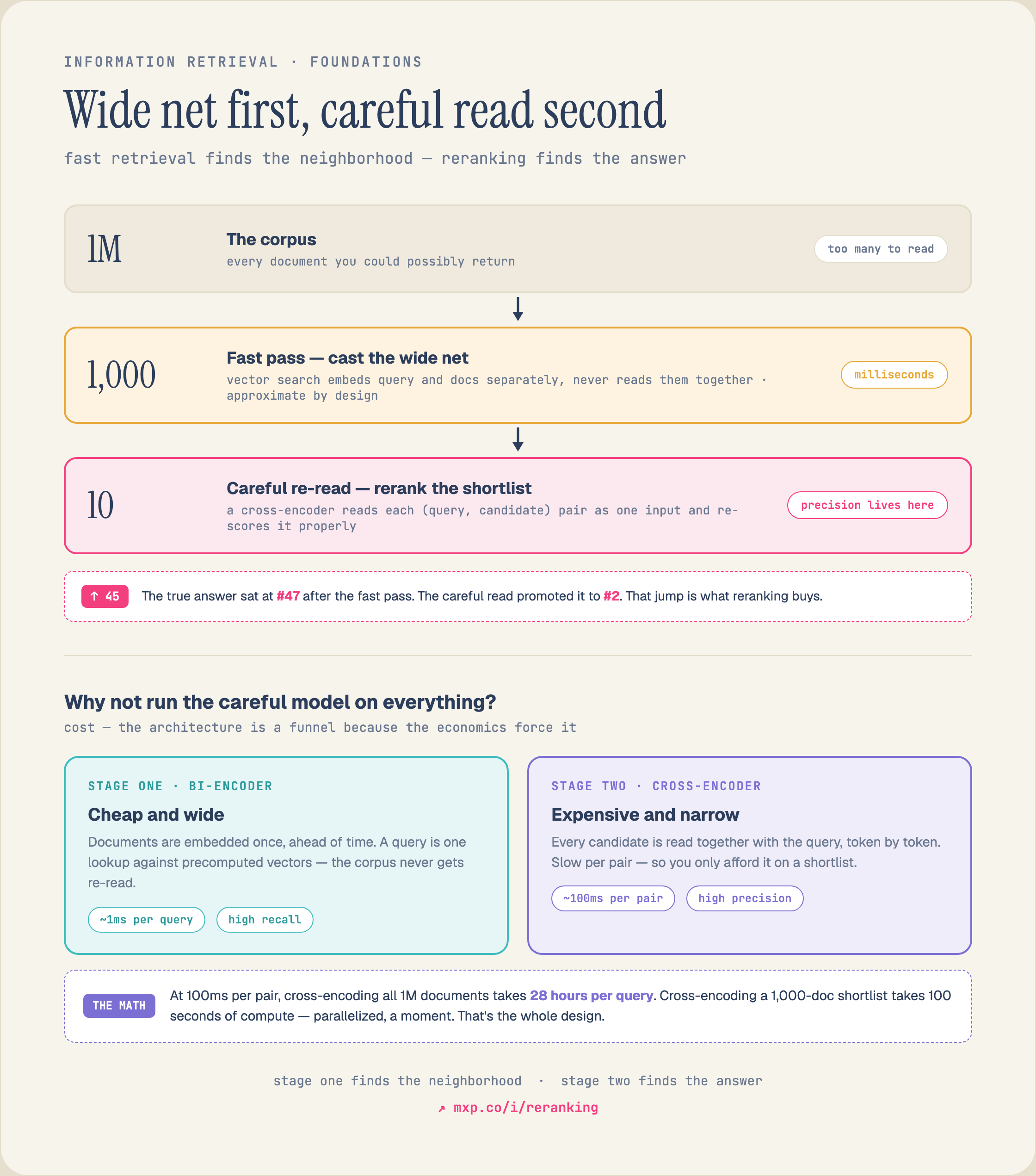
Your vector search returns the top 10 by similarity. The uncomfortable part: those usually aren't the true top 10.
Fast retrieval is approximate by design. It embeds the query and each document separately, never reading them together, so it misses subtle relevance. The fix is a second stage: take the top 1,000 candidates, run a cross-encoder that reads each query and document as one input, and re-score. Results move 40 places. The document sitting at #47 was the actual answer, and now it's #2.
Why not run the careful model on everything? Cost. At roughly 100ms per pair you can afford a shortlist, not a corpus. So the architecture is a funnel: cheap and wide, then expensive and narrow.
Reranking is a stage in every Mixpeek retriever because it's the single biggest precision lever we see, and most teams skip it until they're desperate.
Stage one finds the neighborhood. Stage two finds the answer.
Where this diagram appears
Run this on your own data
Mixpeek turns video, images, audio, and documents in your object storage into searchable, timestamped results through one API.
Search your own data