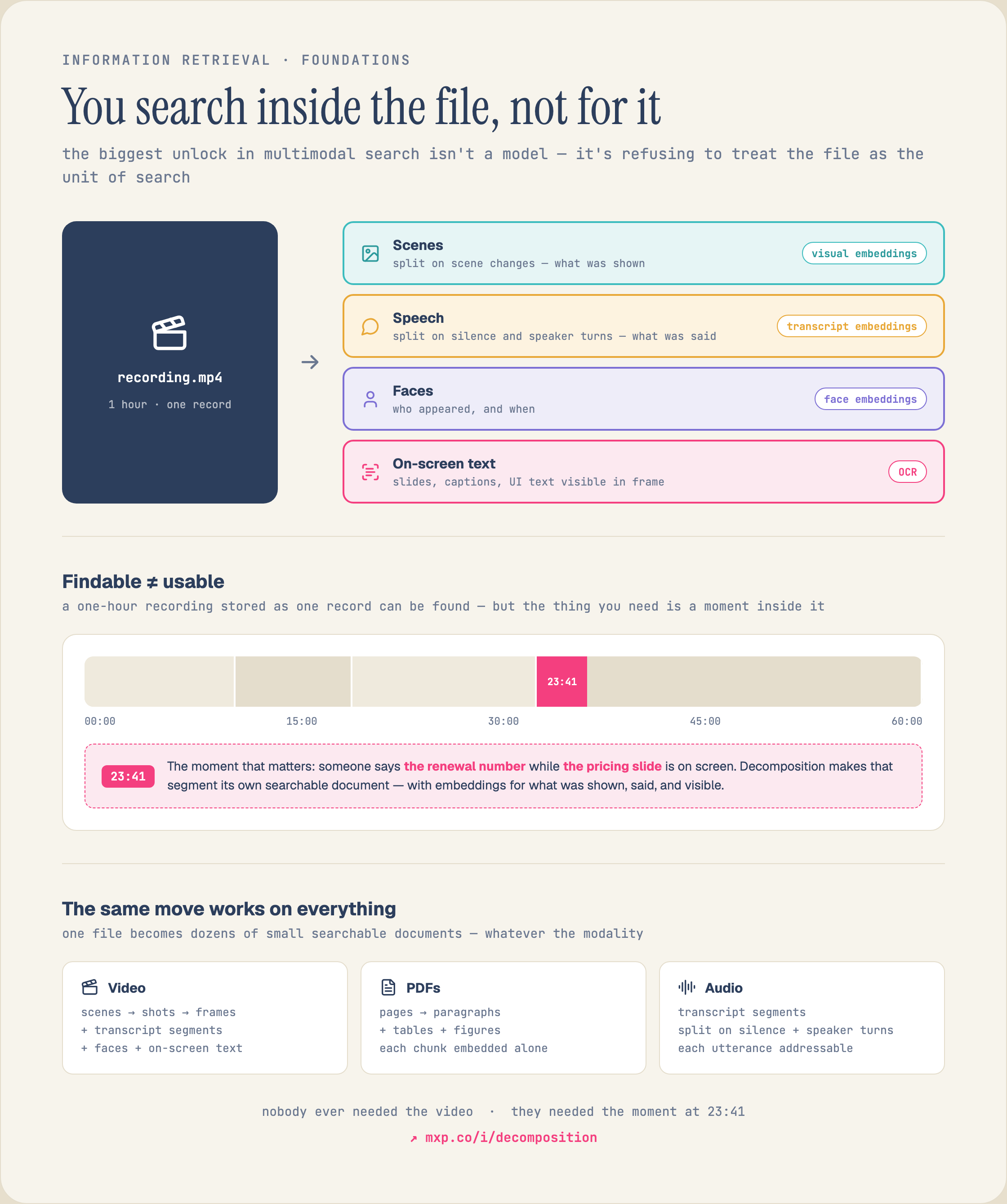
Video RAG: Why Retrieval Over Video Is Not Retrieval Over Text
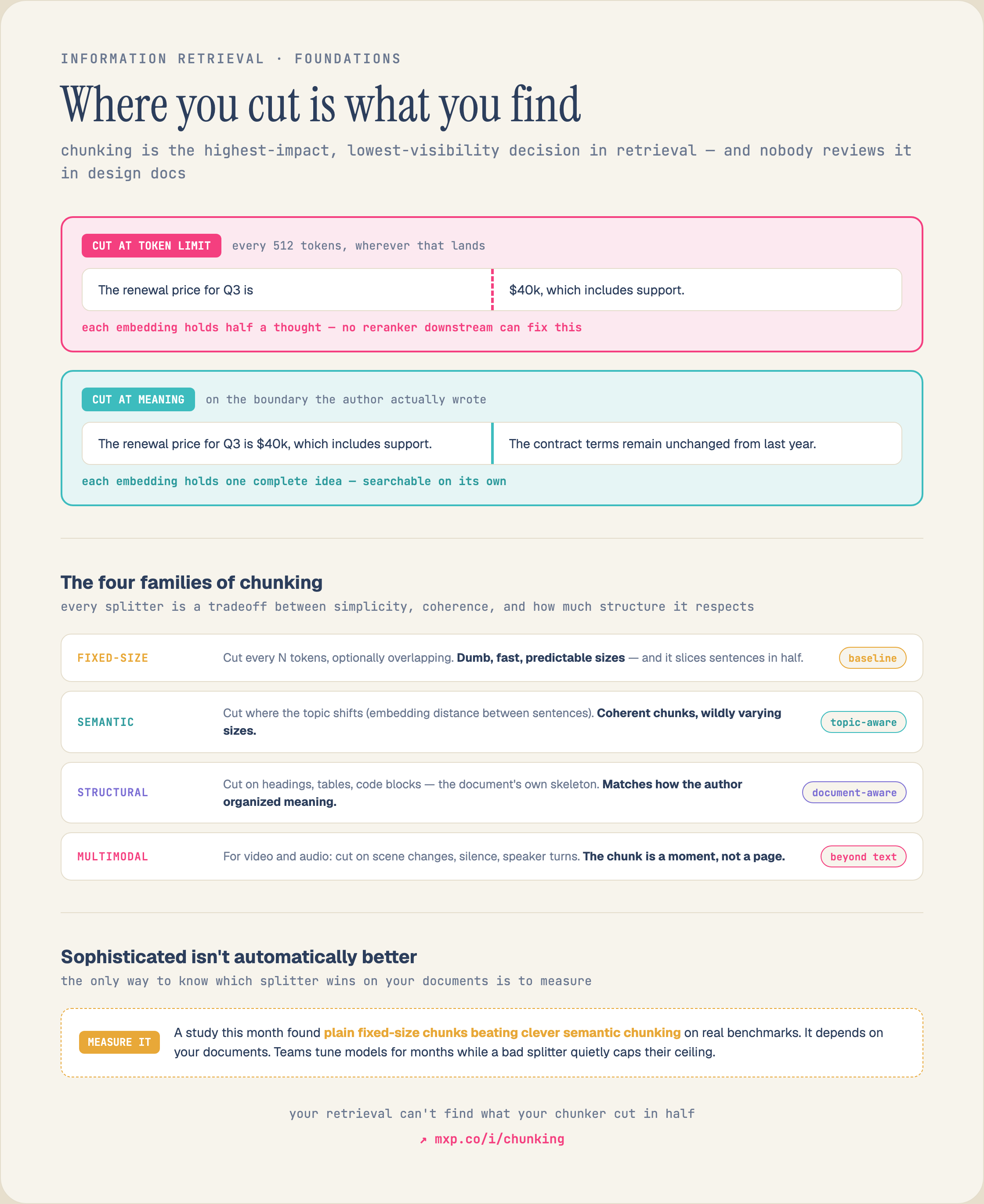
Text RAG gets chunk boundaries, one modality, and small units for free. Video gives you none of them, so every stage of the pipeline is redesigned.
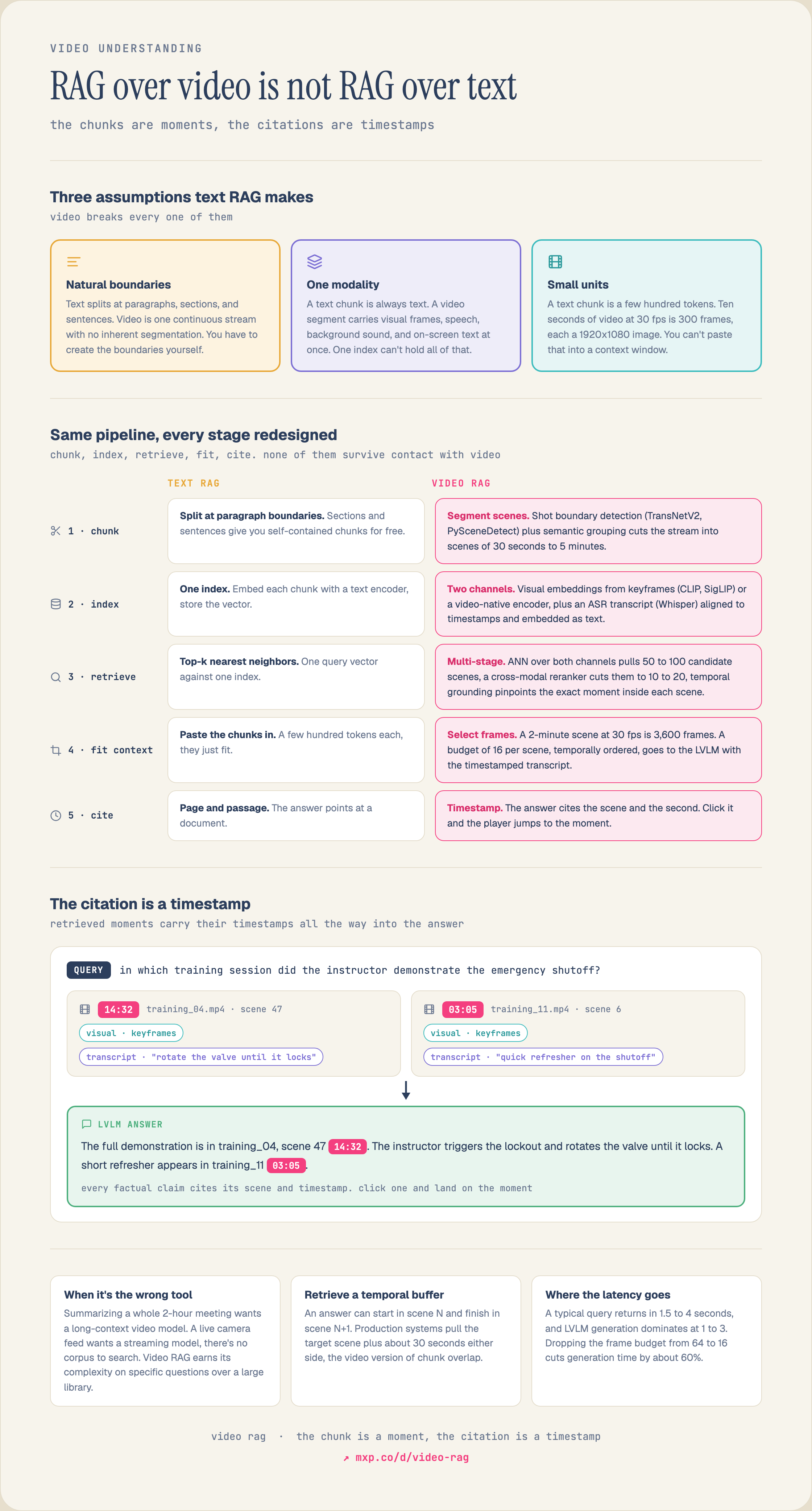
Text RAG works because text hands you three things for free: natural chunk boundaries at paragraphs and sections, a uniform modality where a chunk is always text, and small retrieval units of a few hundred tokens that drop straight into a prompt. Video gives you none of them. It is a continuous stream with no inherent segmentation, a single segment carries frames, speech, background sound, and on-screen text at once, and ten seconds at 30 fps is already 300 full-resolution images.
So every stage of the pipeline gets redesigned. Chunking becomes scene segmentation, using shot boundary detection (TransNetV2, PySceneDetect) plus semantic grouping into scene-level chunks of 30 seconds to 5 minutes. One index becomes dual-channel indexing: visual embeddings from keyframes (CLIP, SigLIP) alongside an ASR transcript (Whisper) aligned to timestamps and embedded as text. Retrieval becomes multi-stage: ANN pulls 50 to 100 candidates, cross-modal reranking cuts to 10 to 20, and temporal grounding pinpoints the exact start and end inside a scene. Context assembly becomes frame selection, since a 2 minute scene is 3,600 frames and a large vision-language model wants about 16 of them, temporally ordered, with diminishing returns past 32 to 64.
The payoff is the last stage. The answer cites the source scene and a timestamp, and the user clicks it to jump to the exact moment. The retrieved moments carry their timestamps all the way into the answer, which is the thing text RAG never had to think about and video RAG is built around.
Where this diagram appears
Run this on your own data
Mixpeek turns video, images, audio, and documents in your object storage into searchable, timestamped results through one API.
Search your own data