Reverse Video Search: A Clip Is a Trajectory, Not a Point
Why image reverse-search matches a point and video reverse-search matches a path.
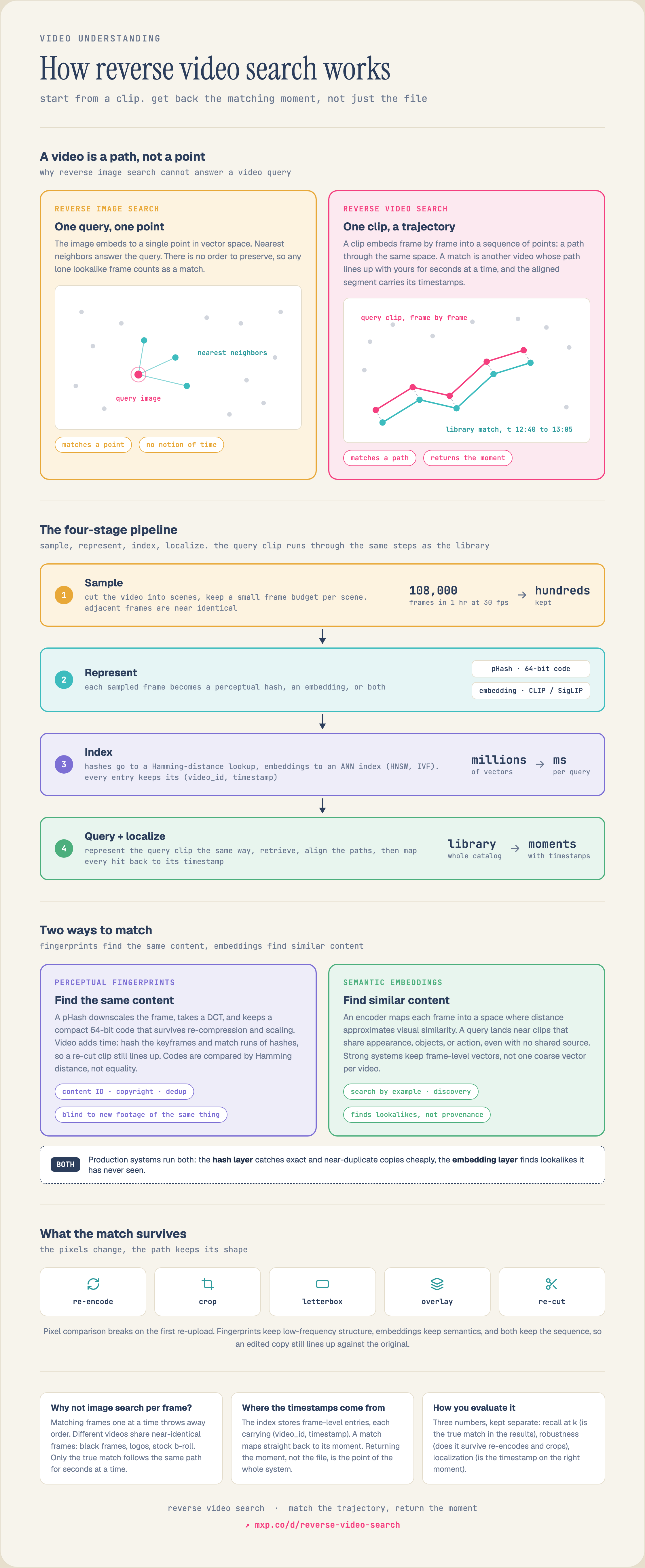
Reverse image search matches a point. Embed the query image, return its nearest neighbors, done. A video is a sequence, so a clip embeds frame by frame into a trajectory through the same space: and matching means finding another video whose path lines up with yours for seconds at a time.
That one distinction explains both of the things people find surprising about reverse video search.
It explains why frame-by-frame image search fails on video. Lookalike frames are everywhere: logos, black frames, stock b-roll. Any of them will happily match the wrong video. Order is what disambiguates: a run of frames in sequence is a far stronger signal than any single frame, however good the match.
And it explains why the match survives re-encodes, crops, letterboxing, overlays, and re-cuts. The pixels change. The path keeps its shape.
The pipeline is four stages. Sample frames (at 30fps a single hour is 108,000 of them, so you spend a frame budget per scene rather than on every frame). Represent each one, either as a perceptual fingerprint or as a semantic embedding. Index them with a (video_id, timestamp) payload attached to every entry. Then localize: return the moment, not the file.
The representation choice is really a question about what you are asking. Perceptual fingerprinting (pHash: downscale, DCT, threshold the low-frequency coefficients into a 64-bit code, compare by Hamming distance over temporal runs) answers "have I seen this exact content before?": it is how content ID, copyright, and dedup systems work. Semantic embeddings (CLIP or SigLIP encoders, ANN over HNSW or IVF) answer "show me footage like this": lookalikes, not provenance. Frame-level vectors beat one coarse vector per video. Production systems often run both: a cheap fingerprint pass for duplicates, then embedding search for discovery.
Evaluate on three axes, not one: recall at k, robustness (re-encode, crop, letterbox and overlay your query clips, then confirm the match survives), and localization, did it return the right moment, or just the right file?
Where this diagram appears
Run this on your own data
Mixpeek turns video, images, audio, and documents in your object storage into searchable, timestamped results through one API.
Search your own data